

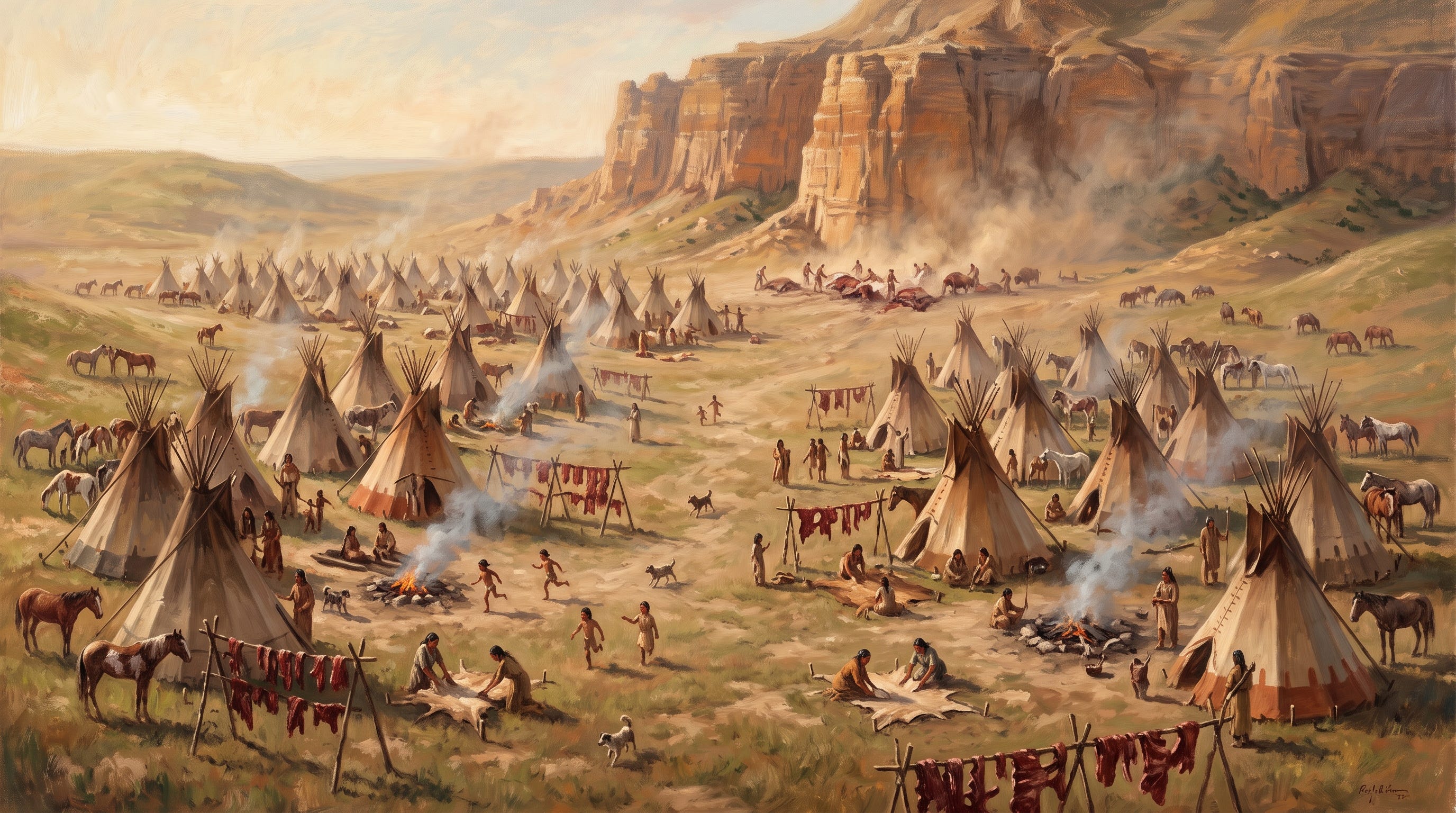
One: Stone Face
“I accept your terms,” New Needle said. “I do not accept your hand.”
I’d expected as much. I left my hand where it was a moment longer than I needed to, so he’d have to be the one to look away first, and he did.
We’d been talking terms for an hour by then. Coldpine wanted a third share off the top before the general division, on account of the distance they’d come and the size of their camp.
A third was more than the count would bear if Duskhorn and Tallgrass were to leave satisfied. He knew this. It’s why he made the demand. A third instead of a quarter. The Coldpine bear old grudges. They are unreasonable in their demands..
We settled on a quarter within a few exchanges, both of us knowing that’s where it was always going to end.
“Forty-one off the bluff, total. Your share is ten head and the shoulder fat off two additional. We Longwater count by mouths, not tents. You know this.”
“By mouths.” He virtually spit the words out. “Coldpine count by tents.”
“Longwater counts by mouths. It’s my count to keep.”
New Needle has never once, in the years I’ve dealt with him, spent effort on a fight he couldn’t win. That’s the difference between him and the men under him.
The Coldpine elders remembered exactly what my grandfather did to earn Coldpine’s distrust, the particular insult of it, the name of the man it happened to. New Needle is the last man in his camp who still knows the actual event behind the grudge. When he’s gone, it’ll just be “the way things are.”
The young ones don’t carry the story anymore. They carry the residue of it. Ask one of his warriors why Coldpine disdains the Longwater and you’ll get a shrug. Like a coat handed down to a son.
“Your grandfather,” he said, because he never lets a negotiation finish without saying it once, “took more than he was owed from a Coldpine hunt and called it fair because not one Coldpine was left standing to defend.”
“I’ve heard the story.”
“You’ve heard your version.”
“I’ve heard yours too. Twice, this hour.”
That got something close to a laugh out of him, short, dry, gone before it arrived. He’s an old man who’s spent a long life being right about most things. There’s a certain kind of weariness in a man like that. I expect it of myself one day, assuming I live to be as inconvenient to the young as he is.
“A quarter, then,” he said. “And Coldpine takes the fat off two shoulder cuts. Yours can have the rest.”
“Done.”
He put his hand out that time, and I took it. We finished the terms standing in the wind with the smell of the kill site already reaching us from three miles off.
When he walked back toward his own fires I watched him go the way you watch a man you’ve spent an hour being careful with. Not fondly. Just careful. The way you watch a fire you don’t trust to stay banked.
Forty-one head. A quarter to Coldpine, the fat off the shoulders included. Tallgrass and Duskhorn still to settle, and the sun not yet at midday.
Two: The Dance
The fire that night was bigger than any single camp’s fire.
All four camps came to it. The Longwater ring closest to the flame since the ground was theirs, the other three arranged out from that in an order no one had assigned but everyone understood. Children ran the gaps between the rings. Dogs worked the edges for scraps.
The singing started low, one voice, then three, then more and more, the kind of singing that was more about joining in than being heard. An old old tune that passed to every tribe from the ancient wind. No one had a name for it, everyone knew it. Spirit of the buffalo, hear my plea. We adore you, you bring us life…
The four chiefs came down together as the song built. Mist-Walker first, the Longwater chief of many years, now old and slow, a carved stick as balance. New Needle beside him. The Tallgrass elder and the Duskhorn headman a step behind, the four of them walking the outer ring once, unhurried, seen by every fire in turn. They didn’t speak. The four men walking together told the whole story. They sang the hunt song for a bit. The youngest of them, Turns Clay of the Tallgrass fire, did a moment of the hunt dance. Then they turned off toward the smaller council fire, set apart from the rest. Nobody followed them.
The dancing that Turns Clay started came up out of the singing. Bodies moving until the whole ring was moving. Then the buffalo heads came out, a dozen men wearing the horned skulls and matted hide over their own heads and shoulders, moving low, lurching, heavy, working the space the way the real herd worked open ground. A second line of men came at them from the flanks, driving them, turning them, walking them slowly toward a line of rocks placed in the dirt that stood in for the drop.
One buffalo-headed man broke early from the line, same as a real one would, and the drivers closed on him fast. He went down under three men at once to a sound from the whole ring that was half laughter and half something much older. He got up covered in dust and grinning under the skull’s dead eyes. The dance kept moving around him like water closing over a stone.
Little Cloud stood near the edge of the Longwater ring, close enough to feel the fire’s heat. Fast Horse came up beside her at some point in it without either of them making anything of the arriving. They didn’t speak much. He said something short about one of the buffalo-headed men’s footwork, and she said something shorter back, and for the length of one full turn of the dance neither of them was watching the dancers.
Stone Face saw it from across the ring, the way a hunt-leader sees most things without appearing to look for them, filed it away in the plain, unbothered way a man files away something he already suspected and now simply knows.
The dancing ran until the fire had burned down past its highest point. The singing thinned out toward the end, fewer voices, then just the young ones who never seemed to tire of dancing. Then, gradually, none. People peeled off toward their own fires in twos and threes. The buffalo heads came off, and by the time the coals had gone from orange to red, the great ring had broken itself back down into four camps again, each one already turning its thoughts toward the morning and the ground they meant to run.
Three: Stone Face
The ground told you before your eyes did.
A shudder came up through your feet first. Faint, then loud. Two thousand buffalo, packed tight.
Eight of us had horses, traded up from the south over the last several seasons. The horses brought speed. No cover. A bull can hook a running horse under you without breaking stride.
The wolf-skins went in on foot first, working the flanks. Long minutes of nothing changing. Then the near edge began to bend away from them. The whole mass turned like water finding a new channel.
The horsemen started to gallop.
Running next to two thousand buffalo is exacting. You run beside a wall that can kill you by simply continuing in the direction it’s already moving. You don’t outrun it. You bend it, a few degrees at a time.
The dust took the sun out of the sky inside the first hundred strides. After that you ran by sound and by the pressure of bodies you couldn’t see. The low thunder of hooves, felt in the jaw and the chest more than heard, and under it the bawling of animals that had lost the herd’s shape and didn’t know anymore where safety was, which meant they didn’t know where danger was either, which meant they went wherever the animal beside them went.
A rider went low over the neck and cut across open ground, closing in seconds what would have cost a foot-runner a quarter mile. The section of herd that had started to break wide came back into the line. Another rider did the same thing a hundred strides on. The herd found the soft places over and over again.
A horseman was there, closing the gap each time, closer to the huge animals than you want to get if on foot.
Two of the eight horsemen were thrown before we reached the drop. One went down under his own horse when the ground gave out beneath it. He came up running on foot, blood down the side of his face, back to the edge before anyone could tell him not to be.
Most of the herd never came near the drop at all. The lead animals felt the ground firm up wrong underfoot, felt the wind change where the land fell away, and the whole front third of the herd peeled off left in one motion — thousands of pounds of animal choosing the open plain the instant the drop became real to them.
It wasn’t buffalo and hunters anymore. Men and animals both were close enough to the edge that going forward and going over had become the same motion for anything that slipped.
I went down twice. Partway through, there was the boy — that’s its own account. The second time was ground I should have read better. Braids-the-Smoke’s voice, not a memory of it, her voice itself: left hand, move now!
My palm found the ground half a stride left of where it was already going, and that half-stride kept a hoof off of it.
Forty-one went over. I walked the base with two Longwater men and counted them myself once the dust had settled enough to trust the count.
The rest of the herd was a mile off across the mesa top inside the hour, grazing.
We stood at the bottom a while, getting our breath back.
Four: Little Cloud
The second vat had gone from a rolling boil to nothing in the time it took to argue about it.
Little Cloud saw it before anyone else did — the grease sitting flat and cooling at the rim, no bubbles breaking the surface — and she said so. Runs at Night talked over her before the sentence was finished.
“Let it sit,” he said. “Cold grease binds tighter.”
“Cold grease doesn’t bind at all. It skins.”
“You don’t know.” He didn’t look at her when he said it. He looked at the other men standing near the fire. Nobody corrected him. The silence did.
She turned back to the racks instead of answering. Three days into it and her hands already knew things her mind hadn’t caught up to, which strips had gone glassy and would keep, which still held a give in the middle. That meant another day of sun, which they didn’t have. The western sky had gone the color of a bruise and the wind had swung around. Rain on half-dried meat was worse than no meat at all. It rotted from the inside where you couldn’t see it happening.
“That whole rack,” she said, pointing. “Down, now, before it turns.”
Runs at Night: “It’s not ready.”
“It’s readier than it’ll be once it’s wet.”
A boy she didn’t know — Coldpine, by the cut of his hair — stood holding two dripping quarters he had nowhere to put, waiting for someone to tell him which fire took priority, her meat boiler or the one twenty feet off where an old woman was rendering bone grease with a patience Little Cloud didn’t have time to admire.
Behind him another argument had started about the calf hides, whether to scrape them now while the light held or let them cure another night on the frames, and underneath both arguments a smell she didn’t want to address yet, the carcasses too long past first light, the flies finding the parts nobody had gotten to.
Four fires. Six people who thought they knew better than the woman actually responsible for whether any of it kept through the winter. She could feel the tired that was still in her chest. The tired that came before the arms gave out.
“Rack down,” she said again, and nobody moved, and for one long breath she understood, completely, that she did not know what to do next. Not which fire, not which hide, not which argument to win first. The not-knowing was going to cost them meat. And winter without meat gets cold.
And then the smell came off the wind. Sweetgrass, unmistakable, from some fire she couldn’t see and didn’t look for, carried in low under the smoke and the blood-smell and the boy’s dripping quarters, gone again almost as soon as she’d caught it.
Mama. Her hands moved before a thought.
Rack down first. She was already lifting it, already calling two of the younger girls over by name to help carry. Meat at a slow boil could be covered and saved. The vat could be rebuilt. Raw meat lost to the rain was gone forever.
She sent Runs at Night to rebuild the fire. Tending the fire forced him to do something besides argue. The Coldpine boy she pointed toward the old woman’s fire.
The covered hides could wait for morning. Nothing about hide would spoil in moonlight.
By the time the rack was down and covered, the wind had already carried the sweetgrass away. Was it smoke from a distant fire? Or was her mother, Braids the Smoke, reaching out from the spirit world? She didn’t stop to wonder. There wasn’t time.
Five: Little Cloud
Her father came to the fire without announcing himself, already crouched and working before she’d registered he was there.
He sharpened the dull knives. That was his place now, had been for longer than she liked to count. Not the killing field, not even the butchering, just the steady grinding work of keeping other people’s tools sharp enough to do the work his legs no longer could.
He’d lost the strength in his left side years ago, an accident he didn’t talk about. She’d stopped asking long ago. What was left of him was patient in a way most men his age weren’t, and useful in a way that didn’t earn him much notice.
She’d watched the women’s eyes slide past him the same way they slid past anyone who’d stopped being useful. She hated that about them. She hated it more that some mornings she felt the same thing herself.
“They’re saying there was trouble on the drive,” he said, not looking up from the stone.
“Whose trouble.”
“A Duskhorn boy. Broke early. Stone Face put him down himself, they’re saying, right in the path of the herd.” He turned the blade, checked the edge against his thumb, in the unbothered way he dealt with most things that weren’t directly in front of him. “No stampede. Boy’s not been seen again, last I heard.”
She kept working the rack in front of her, didn’t let her hands slow. “Stone Face say anything else?”
“Wouldn’t know. Wasn’t there.” He handed her back a knife, handle-first, already testing the next one. “You’d have to ask someone closer to him for that.”
He said Stone Face’s name the way he said anyone’s name — plain, no more weight on it than on Runs at Night’s or the old woman’s at the second fire.
She’d wondered about it. She’d asked her mother once, years back. Before she died. No answer that told anything. Little Cloud let it go. Knowing isn’t going to feed anybody in winter.
“Good hunt otherwise?”
“Good count. Forty-one off the bluff, and the herd’s still on the mesa. That’s what I’ve heard.” He set the sharpened knife on the hide beside him, careful, the blade turned in. “You’ll want that second vat running steady by then. Whatever went on with it earlier.”
He’d heard about that too, then. Word moved through a camp this size faster than smoke off a fire.
“It’s running,” she said.
“I know it is.” He picked up the next knife.
She let that sit, the closest thing to a compliment he ever gave. She went back to the rack. Didn’t notice him again until the whole line of knives lay finished at his side, each one turned the same careful way, each one exactly as sharp as the last, the one thing in the whole camp she never had to check.
Six: Stone Face
I’d marked the boy before we ever moved the herd.
Small through the shoulders, younger than his father let on. Nervous. Not so much fear. More like a man watching himself from a slight distance, already writing the story he’d tell later. I’ve seen it before. Enough to know he wouldn’t wait for reasons. He’d find one.
I told his father he should sit this drive out, that there’d be another season for him. His father said the boy had earned his place the same as the other Duskhorn sons. That was true enough. It didn’t change what I’d seen in the boy’s hands and eyes the night before, turning his knife over and over by the fire.
We had them moving well. The line held, the wolf-skins did their work well, kept the herd moving exactly where we needed it to go.
Then the boy jumped.
He came up out of the low ground too soon, arms wide, undisciplined sound spilling out of his throat. The buffalo nearest him broke stride, started throwing their heads. Behind them the whole rear of the herd began to catch the fear off them the way fear moves through a herd.
I was closer to him than anyone. I went at him low, the way you go at a man you mean to put down for good, not the way you go at a boy who needs pulling back. He went down hard. I went down with him, and for two breaths I was on the ground with animals a few feet away and closing.
Up. I stood up quickly. One of my Longwater men had the sense to grab the boy the second I let go of him, hauled him clear while I got my own senses back, and the herd found its line again. Still not sure how we got so lucky. The herd kept running where it was meant to run. We lost nothing we could count.
I stood the boy up and I hit him, once, open-handed, hard enough that he’ll remember it longer than he’ll remember why he did what he did, and I told him to get back to camp and stay there.
The Longwater men clapped me on the back afterward. The Tallgrass men nodded in agreement. The Coldpine elders looked at me the way they always do.
We finished the drive. The count was good.
The Duskhorn kid’s father found me as soon as I got to camp. He didn’t raise his voice. He asked where his son had gone, the way a man asks a question he suspects has no good answer.
I told him what I knew, which was less than he wanted. Sent back to camp. Not seen since. I didn’t tell him I’d hit the boy hard enough to remember the shape of my own hand afterward. He doubtless had heard that already.
“He’s small for his age,” the father said. Not an accusation. Just a fact, laid down between us like he wanted me to pick it up and answer to it.
“He’s small for the work he was set to do.”
He looked at me a long moment. I’ve had that look aimed at me my whole life — men deciding what they already believe about me before they’ve assessed what is standing in front of them. Coldpine’s worn it longest, but it isn’t only theirs. I know it when I see it on somebody new. He walked off without words.
The camp was working the right way. Loud in the right places, quiet in the right places, everyone with a task and most of them at it.
I found Little Cloud. She had four things going at once and was handling them the way her mother used to handle four things at once. Moving, deciding, moving again. Telling an older man to feed a fire and having him do it without argument, which I noted, because getting an older man to do as he’s told is not always easy.
I didn’t go closer. She didn’t look up.
I turned toward the drive lines to work the cairns, making sure the wind did not blow the brush off them. Work that doesn’t wait. Like the 41 carcasses of buffalo meat.
Behind me I heard Runs at Night’s voice pitch up over something, and then drop again just as fast, like a fire that catches and gutters in the same breath. I didn’t turn around to see who’d put it out. I had a fair guess.
Look for Part Two on Thursday, August 6th!

The Scenic Route

Beau and Gray were cleaning out the shed behind the Guild house. Well, Beau was. Gray had stopped a half hour before and was now leaning on her broom, reading an old issue of Reader’s Digest. Hank and Jean-Paul were off on a road adventure.

I've visited Head Smashed In Buffalo Jump in Alberta. This story makes that place come alive in my mind 🦬🦬🦬🦬🦬🦬
damn dude, well done. nothin other to say except your writing is enviously spectacular.