

There’s a square in Savannah, Georgia that has seen a considerable amount of history. Duels. Declarations. The Savannah kind of afternoon heat that turns reasonable people into philosophers. It has weathered generals and debutantes and at least one documented incident involving a horse that nobody in the historic preservation office will discuss on record.
It was not, in the estimation of the square, prepared for the Southern Writers Guild.
But then, nothing ever really is.
The Victorian on the northeast corner had been a doctor’s office, then a law firm, then a very optimistic bed and breakfast, then nothing for two years. High ceilings. Heart pine floors. A wraparound porch that caught the breeze off the square with the confidence of something that had been catching breezes for a hundred and forty years and intended to keep at it.
Grace found it on a Thursday in February. She walked through it once, stood in the front parlor for forty-five seconds, turned to Hank and Beau, and said: Boys. This is the one.
Hank had questions. Beau had a few thoughts about the kitchen. Neither one asked a follow-up. Grace in a Victorian parlor with that light in her eyes was not a conversation. It was an announcement.
They signed the papers on a Friday and spent the next three months turning a very dignified old house into something that felt like it had always belonged to them. Which is to say: warm, a little chaotic, full of books, and presided over by Jean-Paul.
Jean-Paul claimed the wingback chair in the front parlor on the first day and had not formally relinquished it since. He surveyed the room with the singular composure of a bird who has seen everything and is impressed by very little.
The grand opening was set for the Saturday before Memorial Day. Invitations went out by word of mouth, which in the Guild’s world meant that by Friday afternoon, half of Savannah knew about it and the other half was already trying to figure out parking.
Hank was at the grill by nine in the morning.
This is important to understand about Hank Cotton. The man does not approach a grill. He enters into a relationship with it. He had spent two days sourcing the right wood, had opinions about the charcoal that he would share if you asked and several he would share if you didn’t, and had brought a meat thermometer that looked like it belonged in a laboratory.
By eleven, the smoke rising off the back garden of the Victorian had drifted across the square and into the consciousness of three separate households who had not planned to attend a party but were, increasingly, reconsidering.
By noon, a retired professor named Gerald from the Greek Revival across the square had knocked on the garden gate and asked, very politely, what was on the grill. Hank told him. Gerald said he had to go home and check on something. He returned seventeen minutes later with a bottle of bourbon and a lawn chair and never went home.
The guests began arriving the way good parties gather: not all at once, but in waves, each one raising the water level.
Sarah MacDougal came first, because Sarah MacDougal has never once in her life arrived late to anything that mattered. She came through the front door with a ceramic dish under a kitchen towel and a look of quiet confidence that only a woman carrying something truly good can sustain. The mushroom pie went to the kitchen. Sarah went to the back porch to find Grace.
Fifteen minutes later, Harriet Corvine arrived. She stood in the front parlor, took in the room, noticed Jean-Paul in the wingback chair, nodded at him with genuine respect, and then turned to the nearest person and said: Someone told me there was a mushroom pie.
She was directed to the kitchen.
She and Sarah MacDougal disappeared behind that door at approximately twelve forty-five in the afternoon. What happened in there is not entirely known. There were animated voices. The occasional burst of laughter. What might have been the aroma of a second pie being assembled from available materials. They emerged at two-thirty, slightly flushed, enormously satisfied with themselves, and unwilling to explain anything. The kitchen smelled extraordinary for the rest of the day.
The mystery arrived sometime around one.
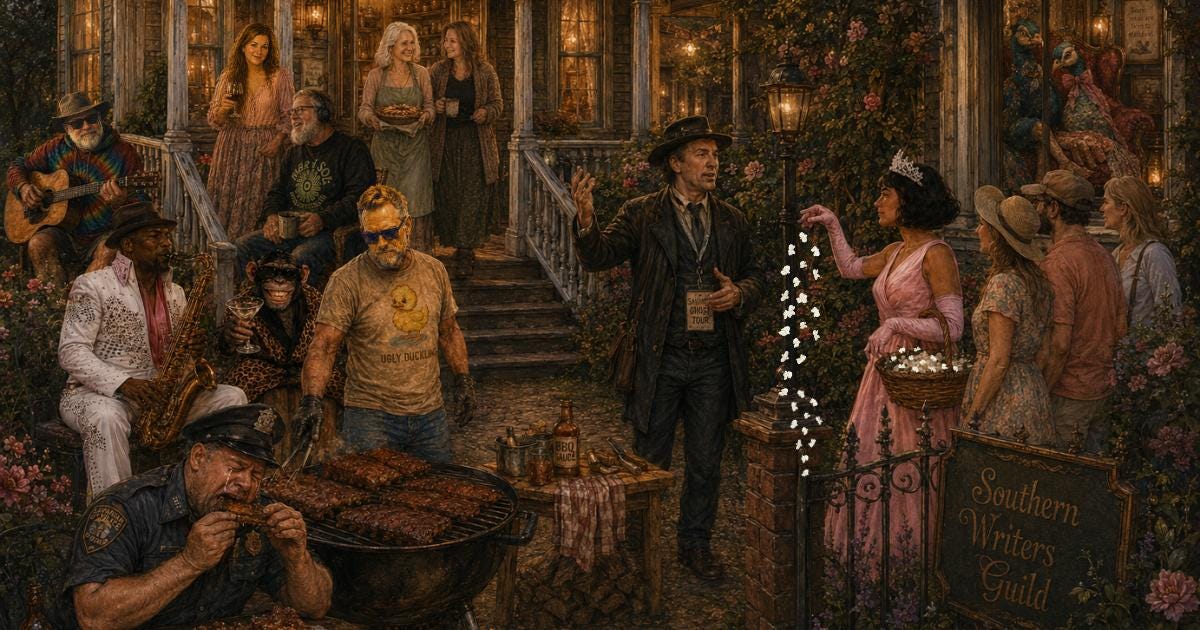
No one saw it happen. One moment the velvet settee in the front parlor held only two decorative pillows and a copy of someone’s manuscript. The next moment, there was a stuffed peacock sitting on it.
Not Jean-Paul. Jean-Paul was in his wingback chair.
This was a different peacock. Same bearing. Same iridescent composure. A pink ribbon at the throat, tied in a bow. She sat on the settee with the stillness of something that had always been there and intended to remain.
Several guests noticed. A few glanced at Jean-Paul, then back at the settee. Bob Beatty, who arrived earlier with a guitar case and a box of pralines from that place on Congress Street, stopped in the parlor doorway for a long moment. He opened his mouth, said nothing. He went to find a drink.
This happened, in various forms, all afternoon. Someone would approach the subject from an angle, get about halfway there, and then veer off as if suddenly remembering somewhere else they needed to be. No one asked. No one said anything. The peacock on the settee sat with the composure of someone who has heard everything you’re about to say and is prepared to wait you out.
Jean-Paul, for his part, surveyed the room from his wingback chair and offered nothing.
Bob found Beau on the back porch. Beau had his guitar out. They had known each other long enough that they didn’t need an introduction to a conversation — they just picked it up somewhere in the middle and kept going.
By one-thirty they were playing together. When Bob set into “In Memory of Elizabeth Reed”, the back garden went quiet in the way of people who recognize something real when it lands in front of them. Not the quiet of interruption — the quiet of attention. El Vas hadn’t arrived yet. The afternoon was still just itself: smoke from the grill, light through the live oaks, and Bob Beatty playing that melody like he’d been carrying it a long time and was finally setting it down somewhere worthy. Beau followed him through it, and in the second pass the music tipped from background into foreground — just briefly, the way good things do — and then eased back before anyone had to decide how to feel about it.
The garden resumed itself. But the temperature had changed. Something had been placed there.
Grace was everywhere. She was on the back porch with a glass of something cold. She was in the front parlor telling a story that had three women crying-laughing. She was at the garden gate greeting Dahlia LeCroix when the guest of honor arrived at two o’clock in a pink sundress and a tiara that caught the Savannah afternoon light like it was designed for exactly that purpose.
Dahlia LeCroix had been the Azalea Queen of Wilmington for one glorious year and had carried the title the way good women carry things that belong to them: lightly, and with full awareness of its weight. She came through the garden gate with a basket on her arm, and before she’d said hello to anyone, she reached into the basket and scattered a handful of dried azalea petals across the garden path.
I do this everywhere, she said to no one in particular. It’s a compulsion.
Grace kissed her on the cheek and said don’t stop, and that was that.
El Vas y los Compriedores arrived at two-fifteen.
They came in a black van with a hand-lettered sign in the window that read PARTY STARTS NOW! and a mariachi horn section visible through the rear windows even before the doors opened. El Vas stepped out in full regalia — not the full Vegas jumpsuit of the Andy’s Starlite incident, but a white linen suit with pink embroidery that suggested someone had asked how much is too much and then set the question aside entirely.
He embraced Beau like a man who had once shared a stage under improbable circumstances and intended to do so again. He shook Hank’s hand over the grill, studied the smoke situation with professional interest, and said, in English: You have done something important here.
Hank nodded, proud, said he’d done what he could.
Within fifteen minutes the Compriedores had set up in the back garden with an efficiency that suggested they did this regularly, and music was coming out of the Southern Writers Guild’s grand opening with a volume and joy that turned heads on the square. Gerald, who had by this point moved his lawn chair into the garden proper, had never been happier in his life.
The afternoon deepened the way good ones do — not by the clock, but by degrees. The garden filled. The parlor filled. The porch filled. The bourbon Gerald had brought was joined by several others. Sarah MacDougal’s mushroom pie appeared in the dining room and was gone within twenty-five minutes. A second one appeared. It was rumored that Harriet had made it. Nobody pressed the question.
Hank moved between the grill and the crowd with the ease of a man who understood both and wasn’t afraid of either. He had fed people before. He intended to feed people now. The ribs came off at three o’clock and the line that formed had a reverential quality usually reserved for outdoor baptisms.
Gerald got in line twice. Nobody said anything.
At three forty-five, a ghost tour stopped on the sidewalk outside the Victorian. This happens in Savannah. The city runs on ghost tours the way other cities run on coffee — constantly, and with great conviction. The guide, a woman in a Victorian walking dress with a lantern, had been delivering her standard remarks about the house’s history when the music and laughter from inside reached the sidewalk at full volume.
She stopped mid-sentence.
Her group of fourteen tourists stood behind her, phones out, confused.
Grace appeared on the front porch with a glass in one hand and her hair doing what it does in the Savannah humidity, and she looked out at the tour group with genuine warmth.
Y’all want some ribs? she said.
The ghost tour guide looked at her lantern. She looked at her group. She made a professional decision.
Four tourists came in. The other ten drifted to the front porch. The guide would later admit that was the most engagement she’d had on a Saturday in months.
Chip Martini arrived at four.
He came in a golf cart, wearing a leopard print robe, holding a martini glass with a precision that suggested it had never once been in danger of spilling regardless of terrain. He climbed out of the cart, surveyed the Victorian with the air of someone assessing a room’s acoustic properties, and made his way to the back garden.
El Vas, to his credit, recognized a professional and stepped back from the microphone without being asked.
What followed was not entirely expected.
Chip Martini set his drink on a garden table, straightened the collar of his robe, and began to croon. The crowd was, at this point, some distance from sober. The afternoon had been warm and generous and the bourbon had been good and El Vas and the Compriedores had loosened everyone to the point where the molecules between people had thinned considerably. Inhibition had largely departed. What remained was a garden full of writers and musicians and an Azalea Queen and a retired professor named Gerald and four ghost tour tourists who had never once expected their Saturday to turn out like this.
Chip Martini gave them a gospel song.
He gave it to them like it was a gift he’d been holding for a while and had finally found the right room. His voice had a quality that no one present could have accurately predicted and none of them would have believed if told in advance. The Compriedores, entirely unbidden, fell in quietly behind him.
The crowd went still the way crowds go still when something true is happening.
Then it was over, and the applause that followed had the quality of people who had been somewhere unexpected and were grateful for the trip. Gerald was weeping openly. He didn’t seem embarrassed about it.
Chip retrieved his dry martini, shaken not stirred, nodded at the room, and went to check out the mushroom pie situation.
Gerald drifted toward Grace. He had the look of a man for whom the afternoon had dissolved several ordinary precautions. He nodded in the general direction of the parlor. She’s been there all day, he said. The one on the settee.
Grace looked at him with the patient warmth of someone who has been asked the right question and intends to answer it honestly.
She’s with Jean-Paul, Grace said. Grace had no idea who this new bird was.
She refilled Gerald’s glass. Gerald nodded slowly, the way a man nods when something he didn’t understand has been explained in a language he still doesn’t speak but feels he should. The conversation moved on. He did not ask again.
No one did.
Dahlia had been circulating all afternoon with the ease of someone who understood that a party is just a series of individual moments and every one of them deserves her full attention. She found one of the ghost tour tourists standing at the edge of the garden, not quite inside the party, with the look of someone who had wandered into something they couldn’t account for. Dahlia gave her some Wilmington sweetness. Five minutes later the tourist was laughing and telling a story about a mountain goat in the Rockies.
A cop pulled up on a motorcycle. Said he had received a noise complaint, but apparently he had received the waft of Hank’s BBQ ribs. He enjoyed the ribs and the noise. And some pie. Last we saw of him he was crying, yes crying, to Dahlia, remembering how much his dad loved Smokey Robinson and the Miracles.
Dahlia took the microphone from El Vas at five o’clock. He yielded it with a small bow. She reached into her basket, scattering azalea petals over the crowd. Just a handful, drifting down into the garden in the late afternoon light. People held out their hands to catch them. Gerald caught one and looked at it like a man who had received an unexpected sacrament.
Then Dahlia LeCroix sang “Raining Blood.” She sang it in the softest voice possible. No drama. No performance. Just Dahlia and a Slayer song and a garden full of people who had not seen that coming.
There was a moment of genuine confusion. You could see it move through the crowd like a small weather system — the recognition of the song, then the dissonance of hearing it this way, then the slow dissolution of the dissonance.
By the second verse, nobody was confused anymore.
El Vas took off his hat and held it against his chest. Bob set down his guitar because playing along felt wrong, like talking during something that deserved to be listened to. Grace stood next to Beau at the back of the garden and didn’t say anything, which for anyone who knows Grace is how you know a moment is real.
When Dahlia finished, the garden was quiet for just a beat. Then the applause came, and it had the same quality as Chip’s gospel song — of people who had been somewhere unexpected and arrived grateful.
Dahlia smiled and scattered the last of the petals from the basket.
I brought enough for everyone, she said.
The finale arrived the way the best ones do — not announced, but assembled.
Someone had learned it was Chip Martini’s birthday. No one was entirely sure how this information entered the party, but by five-thirty it was established fact, and the Southern Writers Guild was not a collection of people who would let that pass without ceremony.
Hank went to the grill.
He took a handful of sparklers — the long ones, the good ones — and arranged them in the rack with the focused deliberation of a man who has never once in his life done anything halfway. Then he lit them.
The grill became a minor spectacle. Sparks fountained into the evening light, gold and white against the Savannah dusk, and the smoke took on a festive quality that Hank would later describe, with characteristic understatement, as a reasonable effect. Then he lit the M-80s.
Chip Martini was located in the parlor, mid-conversation, drink in hand. He was escorted to the garden.
Grace and Beau flanked him. Dahlia LeCroix stepped up on the other side and adjusted her tiara, which had listed slightly starboard during an energetic portion of the Compriedores’ set.
The three of them sang Happy Birthday.
They sang it like it meant something. Beau’s voice underneath it, Grace’s easy harmony above, Dahlia in the middle with a sweetness that made even the simple melody sound like it had been written for exactly this occasion. The Compriedores came in softly on the second chorus, because they couldn’t help themselves and no one wanted them to.
The crowd joined. Gerald was already joining. The four ghost tour tourists were joining. Even the guide on the sidewalk was mouthing the words.
Chip Martini listened to all of it with the expression of a dude who is used to things going well and is genuinely moved when they do.
The sparklers threw light across the garden. The fireworks boomed.
No one noticed Jean-Paul move.
By the time Grace finished the last note of Happy Birthday and the garden applause had settled into the warm ambient noise of a party that knows it has peaked and is content to drift down slowly —
Jean-Paul was on the settee. Next to the mystery bird.
He had not been there a moment before. The mystery bird sat where she had sat all afternoon: still, composed, the pink ribbon at her throat. Jean-Paul settled beside her with the ease of a bird returning to a place he had always known about and had simply been waiting for the right moment to occupy.
The two of them sat together on the velvet settee in the front parlor of the Southern Writers Guild’s Victorian on the square in Savannah, Georgia.
No one asked. No one said a word.
About the Southern Writers Guild

We are the Southern Writers’ Guild: a deliberate assembly of stubborn scribes—poets, novelists, essayists, playwrights, journalists, songwriters—who stake our claim on this tangled South, by blood or by choice or by some inexplicable pull that won’t let go.

That was such fun, and very inspiring! Maybe my Memphis recording studio is not going to go to waste after all... Thanks for the party!
That was quite the party!