

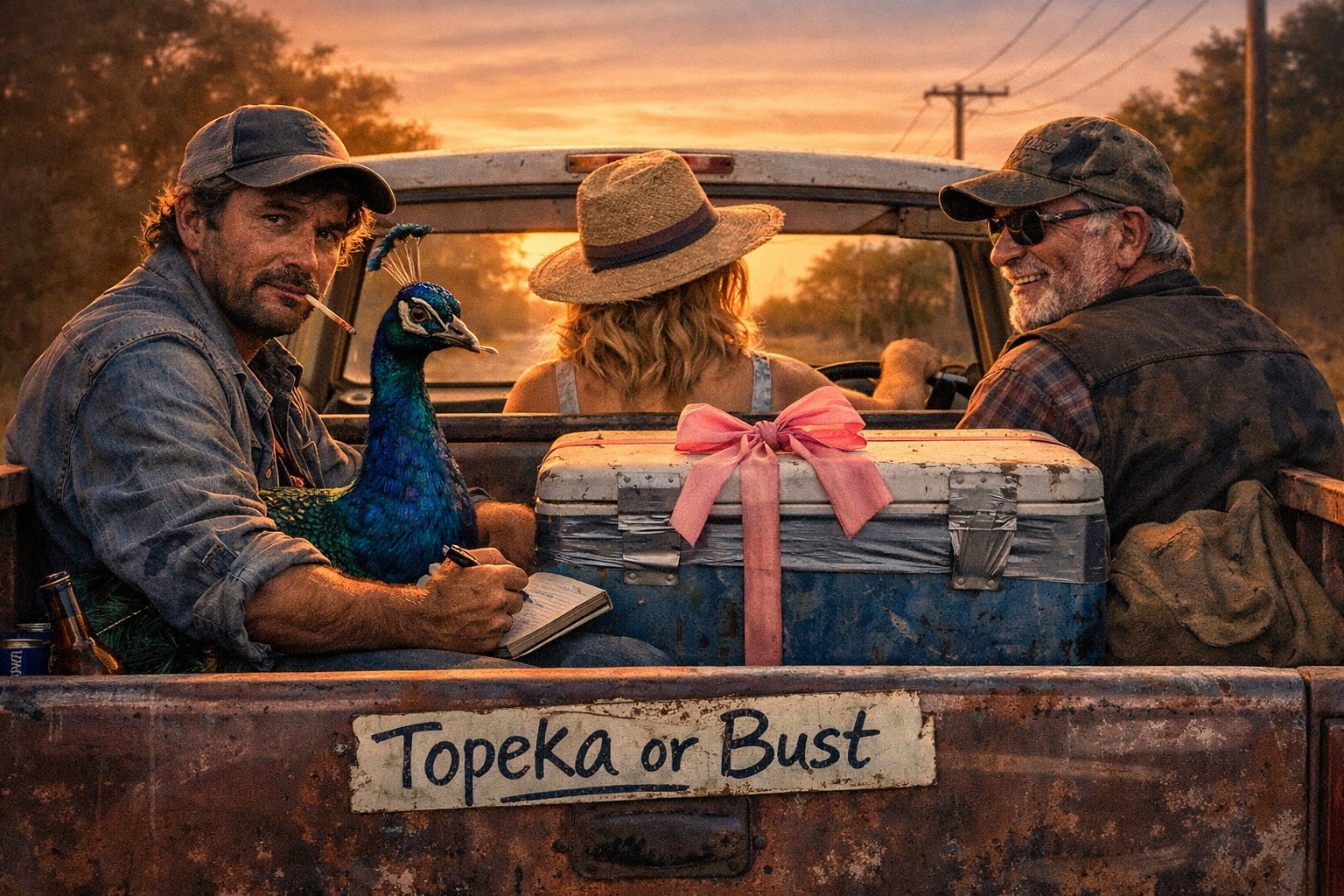
Primalbeet was born Beau Pritchett IV, but nobody has dared say it out loud since the third grade, when he answered to it by putting a frog in the teacher’s coffee. After that, he was just beet. The “primal” got tacked on in college when he showed up to a keg party wearing nothing but Carhartt overalls and said he’d calculated how long it would take the rest of us to die in the woods when the apocalypse hit. But lately, he’s gone back to being Beau.
He grew up on a trout farm outside of Penrose, North Carolina, in a house that smelled like woodsmoke and cathead biscuits. His father raised hunting dogs and collected confederate flags; his mother raised heirloom tomatoes and quiet defiance. Beau learned early that irony is basically grief wearing camouflage. By fifteen he could field-dress a deer, quote Flannery O’Connor, and make moonshine that tasted like a pine tree having a psychic experience.
He left for Chapel Hill with a football scholarship he never really wanted and a duffel bag full of Faulkner paperbacks. Played one season of middle linebacker, broke three helmets (none of them his), then quit the day the coach called a play “Toilet Swirl.” Walked straight to the journalism school, declared a major in “whatever lets me sit in the dark and ruminate,” and never looked back.
Spent the next decade bouncing between dying alt-weeklies and glossy magazines that paid in exposure and artisanal tote bags. Covered swamp preachers, mayors in strip clubs, and a woman in Macon County who swore her pet armadillo could predict SEC scores. Won a couple of awards with articles nobody read, lost a marriage nobody noticed, and developed a liver that functions primarily as a cautionary tale.
These days, he lives in a single-wide trailer outside of Social Circle, Georgia, parked under a water oak that drops limbs like it’s bored. The trailer has no Wi-Fi, one window unit, and a porch swing held together by baling wire and used Juicy Fruit. He writes long, strange essays nobody commissions anymore, drinks gas-station coffee cut with chicory, and keeps a sword by the door, in case the apocalypse is polite enough to knock.
He met Grace at a yard sale in the front pasture of a bankrupt antebellum house outside Madison, the kind of place that looked like Scarlett O’Hara had died falling down the stairs. Everything was priced to move: a cracked chamber pot, a velvet painting of Dale Earnhardt, a carving of Santa in shorts, one dented sousaphone, and, perched on a card table like a pink-feathered czar, a taxidermied peacock.
Beau had shown up with a cooler riding shotgun in his truck, duct tape sealing the lid, a hand-lettered sign he taped to the side that read “MISC. BIOMEDICAL—$40 OBO—NO QUESTIONS.” He found it near a Waffle House dumpster. He figured if nobody bought it he’d just drive it to the Ocmulgee River and let the catfish sort it out.
Grace arrived in a cloud of snickerdoodle perfume and a sundress the color of sunset. She took one look at the peacock, gasped like she’d seen the face of God, and marched straight over. The widow running the sale wanted seventy-five dollars. Grace offered twenty and a jar of fig preserves. The widow held firm. Grace went to twenty-five and a coupon for a free tour of the Pink Tree Atelier. The widow wavered. Grace added a smile so bright it should’ve come with sunglasses. Sold.
Beau, leaning against his tailgate nursing warm PBR, watched the transaction with the weary amusement of a man who’d seen stranger things but not by much.
Grace turned, peacock tucked under one arm like a feather boa, and caught him staring.
“You’re selling the cooler,” she said. Not a question.
“Trying,” he allowed.
“What’s in it?”
“Nothing illegal,” he said. “Probably.”
She studied him the way botanists study new orchids (equal parts fascination and suspicion he might be poisonous). Then she smiled again, smaller this time, like she’d decided he wasn’t.
“I’ll trade you the bird for it,” she offered.
Beau looked at the peacock. One glass eye was cracked; it looked hungover. “That thing’s worth more than my truck, trailer, and my remaining dignity combined.”
“Well,” she said. “So you’d be getting the better deal.”
He should’ve walked away. Instead he heard himself say, “Throw in lunch sometime that isn’t kale and sadness, and we’re square.”
She stuck out her hand, pink nails glittering like butterfly wings. “Deal, mister…?”
“Beau.”
“Grace.” She shook once, firm. “You’ll like the bird. He answers to Jean-Paul.”
That should’ve been the end of it.
But three hours later, Jean-Paul was riding in the bed of Beau’s truck beside the cooler, because Grace’s Civic had declared mutiny and refused to start. Beau offered her a ride into town. She accepted on the condition they stop for boudin at the Chevron in Rutledge. He countered with real barbecue or no deal. She said yes only if they could get banana pudding too. He said only if she promised never to call it “naner puddin’” in his presence. She laughed like a ginger snap.
They ate on the tailgate while Jean-Paul stared at them with aristocratic disdain. Somewhere between the second bite of pulled pork and the part where she told him her life story in seventeen pastel-colored anecdotes, Beau realized two things:
He had not laughed (really laughed) since the night his second wife packed her cello and left the cat.
The cooler was leaking something that might have once had a social security number.
Grace noticed the leak, wrinkled her nose, and without missing a beat said, “Bless your heart, that’s gonna stain the vinyl. Here—” and produced a monogrammed handkerchief the color of ballet slippers. She dabbed at the cooler like it was a skinned knee.
Beau stared at her. “You’re not scared of what might be in there?”
“Honey,” she said, tying the handkerchief in a bow around the handle like a gift, “I grew up in a house with a pet marmot named Cher. Fear is relative.”
That was the exact moment Hank rumbled up in the ’94 Chevy, looking for Beau because “some fool left a cooler full of Lord-knows-what at the Waffle House and a raccoon done run off with it.”
Hank took one look at Grace, the peacock, the cooler wearing a pink bow, and Beau, who said sheepishly, “I may or may not be your raccoon.”
“Shotgun’s empty. Get in. Both of y’all. And somebody hold that damn bird.”
They’ve been an unholy trinity ever since: Grace at the wheel, Hank riding literal shotgun, Beau in the back with the taxidermy and the possibly haunted cargo, scribbling sentences on napkins while the Georgia countryside unspools like ribbon behind them.
Sometimes, late at night when the moon is thin and the cicadas sound like broken radios, Beau will look at the cooler (still wearing its faded pink bow) and think maybe whatever’s inside isn’t organs after all.
Maybe it’s just the last little bit of armor he had left, and Grace just gift-wrapped it so he wouldn’t notice it was gone.
He still hasn’t thanked her. He probably never will. But every time she floors it and that ribbon snaps like a war banner made of sunrise, he feels the fist in his chest unclench another fraction, and he thinks:
Lord have mercy.
This might be how a man gets saved without ever once stepping foot inside a church.