

The first thing Hank noticed was the silence. Not the silence itself. Like the swamp was clearing its throat.
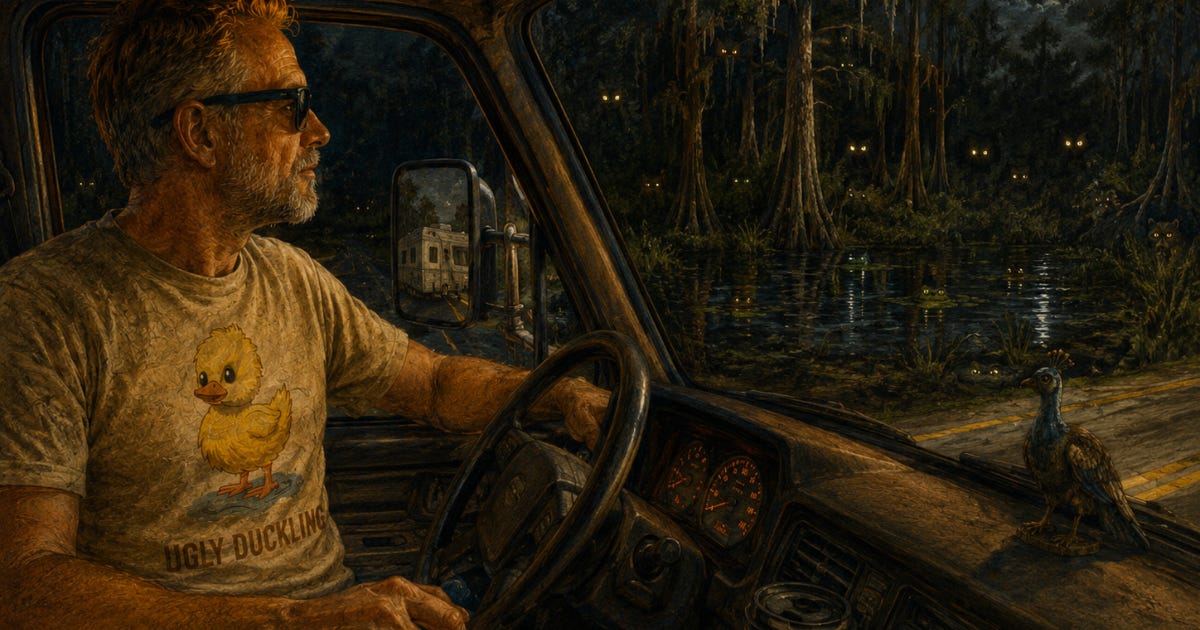
He was southbound on 84, forty minutes past Ludowici, hauling a fifth-wheel for a man in Valdosta who had paid cash and asked no questions, which was Hank’s preferred transaction. The road was flat and dark and the kind of empty that makes you check your mirrors just to make sure…
Then the frogs found him.
It came through the open window all at once, the way a choir sounds when you open the door to a church mid-hymn. Not one frog. Not even a pond’s worth. Something larger than that, something that seemed to be coming from the ground itself and the water in the ditches and the dark tree line and everywhere simultaneously, a sound so unified and so enormous that Hank’s foot came off the accelerator before his brain had issued the instruction.
He couldn’t stop. Regulations. He was already two hours past his window and the last thing he needed was a DOT inspection on the shoulder of 84 at 2am with a cash-paid fifth-wheel and a taxidermied peacock riding shotgun.
He drove through it.
It lasted maybe forty-five seconds. Then the road curved and the sound fell behind him and he was back in ordinary south Georgia night.
Hank drove another mile in complete silence.
He paused long enough at the next stop sign to text Grace and Beau:
driving down here near the okefenokee. dont know what it is. frogs maybe. but not like any frogs i ever heard. like a whole church choir singing at once. awesome, dawgs!
Grace responded in four minutes: what do you mean singing.
Hank thought about how to answer that for a while.
like sirens, he finally said. the greek kind. had to keep driving.
Beau responded eleven minutes later, which meant he’d been awake: where exactly.
sign said delmore county, Hank said. frogtown something.
A few minutes later from Beau’s end: give me a little while.
By the time Hank had unloaded the fifth-wheel in Valdosta and found a truck stop with Wi-Fi, Beau had already been down the rabbit hole for an hour. He called at 4am.
“Delmore County,” Beau said.
“That’s the place.”
“Fighting Croakers,” Beau said. “Their football team. Two and eight this year. Disgrace to the old men who won state in ‘81.” A pause. “They named themselves after the frogs. Been the Fighting Croakers since 1958.”
Hank noted the year. Beau kept going.
The frogs in Delmore County weren’t from Delmore County, or hadn’t always been, or hadn’t always been like this. What they were descended from had come off a freighter out of Sierra Leone docked in Sturgeon Bay, Wisconsin, in the summer of 1952. How they got from the freighter to Sturgeon Bay was not in any record Beau had found. How they got from Sturgeon Bay to Egg Harbor and into the little boy’s shoe box was a mystery. What was documented was a Delmore County Sheriff’s Department incident report from the summer of 1953.
The boy had caught two of the frogs in Egg Harbor and put them in a shoebox with some lettuce in it, because kids don’t know what frogs eat, and tucked the box into the family car before a vacation drive south to Florida. Somewhere south of Screven the frogs got loud enough that the father, apparently lost, in a moment of vacation-ruining pique, grabbed the shoebox and threw it out the window.
“How do you know all that?” Hank was genuinely curious.
“The magic of microfiche and the rigor of meticulous recordkeepers.”
Hank was quiet for a moment. Outside the truck stop the parking lot held nothing of interest. “So everything out there,” he said. “Every ditch, every pond, every night since whenever—”
“Two frogs in a shoebox,” Beau said. “Wisconsin plates. Father having a bad day.”
They picked Beau up at the Georgia Peach World General Store outside Richmond Hill at seven. Beau simply said he was there to see a man about a dog. Then crickets. Neither asked. Jean-Paul was bungeed into the truck bed, Grace in the passenger seat with a thermos of green tea and the alert expression of a woman who has been promised something and is keeping track.
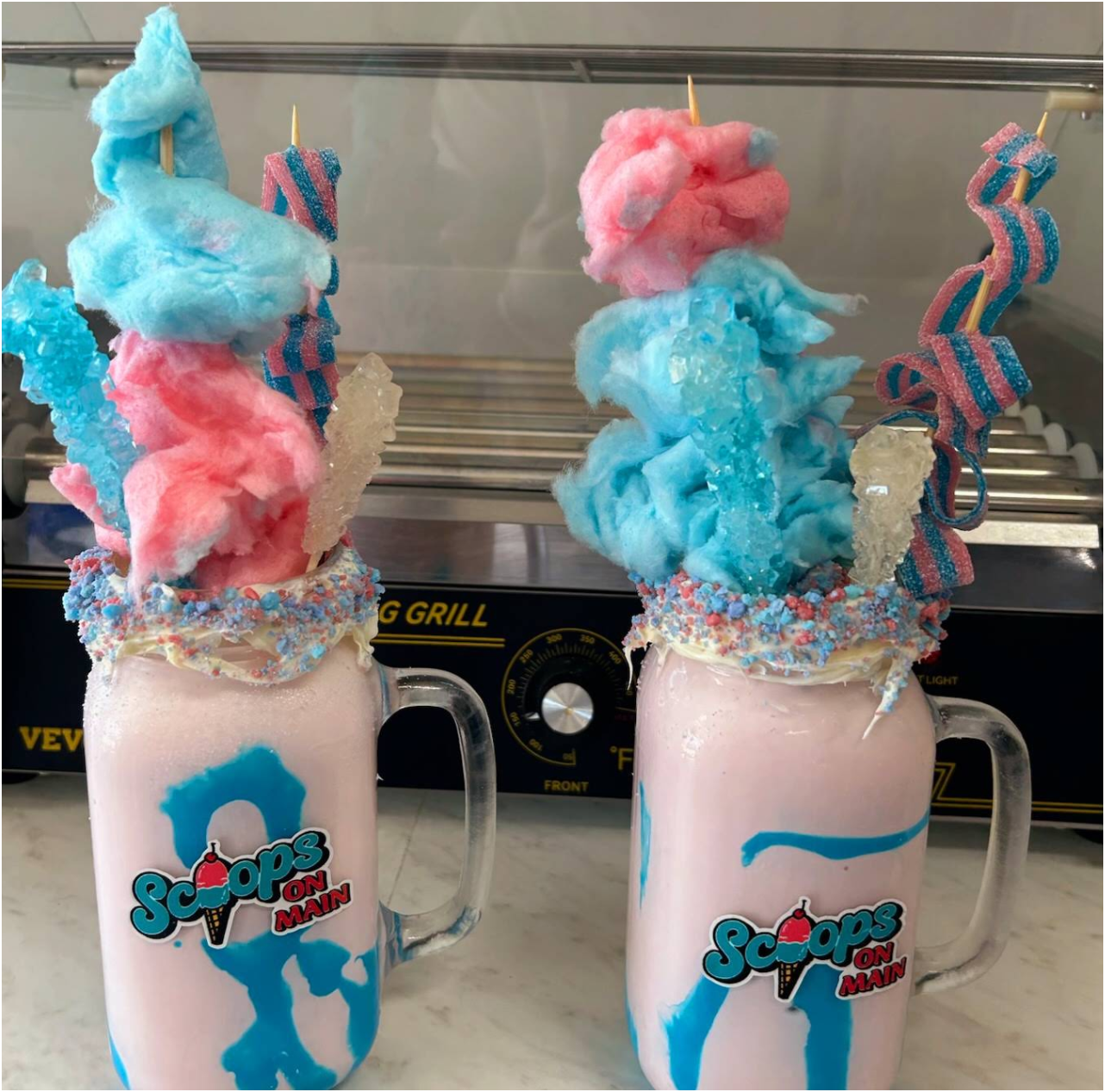
The promise was Scoops on Main in Blackshear. Beau had shown her a photograph. Cotton candy milkshakes in mason jar mugs, candy ribbons spiraling off the top, the whole construction so aggressively pink and blue it looked like a dessert that had made a pact with sugar. Grace had looked at the photograph for a long moment and said fine in the tone she reserved for things she had already decided.
But only after they found the old man.
Beau spread his notes on his knee as the truck headed south. The story came out in pieces, the way Beau told things, not dramatized but assembled, fact laid next to fact until the story appeared on its own.
Delmore County, Georgia. Population forty-one hundred, give or take. Sits on the northern edge of the Okefenokee, which means the water table is approximately two inches below the surface at any given point and the frogs have been in residence since before anyone thought it might be a story. Every low spot holds water. Every water holds frogs. And on still nights — most nights, this close to the swamp — they sing in unison, the whole area, wall to wall, like something enormous is trying to say one single thing in a language that predates English by a considerable margin.
“How long has it been like that,” Grace said.
“That’s the part,” Beau said. “It hasn’t always been like that.”
He found it in the Delmore County historical records, which were online because Olla Mae Washington had put them online, all of it, every document back to 1887, scanned and indexed with a thoroughness that suggested a woman who took the past seriously and didn’t trust the future to handle it properly.
In the records, in the incident log from the summer of 1953, filed by one Deputy H. Stults of the Delmore County Sheriff’s Department:
Vehicle stopped on county road 12 approx. quarter mile south of dumpster facility. Wisconsin plates. Driver cited for littering — box thrown from vehicle window. No other violations. Fine assessed. Driver proceeded south toward Florida.
“That’s it?” Hank said.
“That’s the official record,” Beau said. “But I called Olla Mae.”
Grace turned around from the passenger seat. “You called her.”
“She answered,” Beau said. “It was six-thirty in the morning and she answered on the second ring. Woman has been at her desk since before we were born.” He looked at his notes. “Deputy Stults is still alive.”
The truck went quiet for a moment except for the road noise and the wind through the windows.
“How old,” Grace said.
“Hundred and four,” Beau said.
Grace faced forward again. Looked at the road. “Drive faster,” she said to Hank.
Jean-Paul had been unusually sociable all morning.
This was noted but not discussed, because Jean-Paul’s moods were not something the three of them had developed a formal language for. But he had positioned himself directly behind the cab, his alien eye close in the open rear window. At various points during the drive south Hank had glanced in the mirror and found the bird looking back at him with an expression that, on a living creature, you would have called friendly.
They had gotten close lately, Hank and Jean-Paul. When Hank stopped for gas Jean-Paul tracked him across the lot and back. When Hank laughed at something Jean-Paul’s eye did a slow satisfied blink. It was the kind of closeness that developed between two beings who had spent enough time in the same truck and had arrived at a mutual understanding that didn’t require elaboration.
Grace had theories. She had been assembling them since the party in Savannah, since the mystery bird on the velvet settee in the parlor, since Jean-Paul had settled beside her at the end of the evening with the ease of a creature returning to something he’d been thinking about for a while.
She lasted until Jesup before she said anything.
“Hank.”
“Yeah.”
“The bird at the party.”
Hank’s eyes stayed on the road. “What bird.”
“The one on the settee. The one with the pink ribbon.”
“Lot of birds in Savannah,” Hank said.
“Hank.”
“Grace.”
“Does Jean-Paul have a girlfriend.”
A long pause. Jean-Paul’s eye caught the mirror.
“I’m sworn,” Hank said, “to secrecy.”
Grace opened her mouth. Beau put a hand on her arm. They both looked at the mirror at the same moment.
Jean-Paul’s eye had begun to flutter. Slow at first, then with increasing deliberateness, the blue-green light pulsing in a rhythm that, since Pensacola, had come to mean something. Not a warning exactly. More like a subject being closed from the inside.
Grace turned back around.
“Fine,” she said.
She did a finger wiggle at Hank, hoping JP wouldn’t see it. Fat chance. JP’s eye started fluttering like canvas in a windstorm.
Nobody said anything else about it. The truck went south through the long flat pine corridors of south Georgia, the light coming down gold through the trees, and whatever Jean-Paul knew about the bird on the settee he kept to himself. And, apparently, Hank.
The Restoration Offerman Church of God sat on a county road three miles outside Frogtown proper, white clapboard, tin roof, a marquee sign out front that read WHEN IN DOUBT DON’T and beneath it, in smaller letters, Ser. Sun. 10am Bro. Odell presiding. A single oak spread over the parking lot with the authority of a creature that had been there longer than the people and intended to remain.
Olla Mae Washington was at her desk in the secretary’s office off the fellowship hall, which was where Olla Mae Washington was every weekday morning and had been for forty-one years. She was a small woman, precise, with reading glasses on a beaded chain and the composed expression of someone who has heard most things and filed them correctly.
She looked at the three of them in her doorway and at Jean-Paul, who Hank was carrying because the truck bed had seemed insufficient for an occasion, and she said: “You must be the ones who called.”
“Yes ma’am,” Grace said. “I’m Grace. This is Beau, this is Hank, and this is Jean-Paul.”
Olla Mae regarded Jean-Paul with brief professional neutrality. “He always travel like that?”
“He prefers it,” Hank said.
Olla Mae accepted it with a nod, gestured to the chairs across from her desk. She excused herself for a minute, returned with peanut butter and jelly sandwiches from the church kitchen, cut into triangles, on a paper towel. And a coffee urn.
Beau laid out what he had found. The Wisconsin plates. The incident report. The shoebox. The freighter from Sierra Leone, the frogs in Sturgeon Bay, the boy who’d caught them and smuggled them south in a shoebox with some lettuce in it because kids don’t know what frogs eat. The box flying out the window on county road 12 in the summer of 1953.
Olla Mae listened without interrupting. She had listened to a great many things in this office and knew that the story only appeared when you let it finish.
When Beau stopped talking she was quiet for a moment.
“Hamner’s been telling that story since I was a girl,” she said.
“You didn’t believe him,” Grace said.
Olla Mae took off her glasses and cleaned them with the hem of her cardigan. Put them back on. “Hamner Stults doesn’t come to church,” she said. “Never has. Not once in a hundred and four years.” A fact that did double duty as a verdict.
“But the records,” Beau said.
“The records say he wrote a ticket,” Olla Mae said. “The records don’t say what was in the box.”
“He went back,” Beau said. “After he sent them on their way. He went back and looked.”
Olla Mae was quiet again.
“Abner Jefferson told Effie Starks,” Grace said. Not pushing. Just placing it on the desk between them like something that had been in her pocket the whole drive down.
Olla Mae looked at her.
“Abner told Effie at church,” Grace said. “Before he died. That he’d pulled over on County Farm Road that afternoon in his flatbed and found Hamner in his deputy suit, out in the ditch, trying to catch frogs. Said it was the strangest thing he’d ever seen.”
The fellowship hall was very quiet. Outside a mockingbird made a series of increasingly ambitious claims.
“Effie Starks has been dead twenty years,” Olla Mae said. “Abner too.”
“Yes ma’am,” Grace said.
Another silence. Olla Mae looked at the plate of untouched sandwiches. Looked at the wall. Looked at something that wasn’t in the room.
“Well,” she said finally. “I suppose you’d better take me to see the old man.”
Hamner Stults lived four miles outside Frogtown in a brick ranch house the color of old cream, set back from the road behind a row of crepe myrtles that had not been trimmed in several years and were expressing themselves freely. A wheelchair ramp had been added to the front porch at some point, pine, newer than everything else. Wind chimes made from what appeared to be old badges hung by the door.
His granddaughter answered. She looked at the four of them and Jean-Paul and said “Lord” in a tone that was not entirely unwelcoming, showed them to the back porch where Hamner was in a rocker with a blanket across his knees despite the heat. At a hundred and four you have earned the right to be cold whenever you want.
He was small and folded and completely alert. His eyes found each of them in turn with the quick assessment of a man who had spent decades reading people on roadsides and had not lost the habit.
“Olla Mae,” he said.
“Hamner,” she said.
The history between them was long and specific and neither of them elaborated on it. Grace pulled up a porch chair close to his rocker. Beau hung back with his notebook. Hank stood at the porch rail with Jean-Paul and looked out at the yard, which backed up to a drainage ditch thick with cattails.
“Mr. Stults,” Grace said. “We came about the frogs.”
Hamner’s face arranged itself into something that was not quite a smile. “Took you long enough,” he said.
He told it the way very old men tell things they have told many times — not performed, just the facts, ma’am, the details worn smooth. The Wisconsin plates. The box flying out the window. Pulling them over on county road 12, the father indignant, the boy in the back seat looking at his shoes, the mother staring straight ahead with the expression of a woman who had chosen her battles and this was not one of them. The ticket. Fine to be paid by mail. Drive safe now. Did he mention the Wisconsin plates?
And then going back.
“I knew something was in that box,” Hamner said. “Man doesn’t throw a box out a window like that unless there’s something in it he’s decided he doesn’t want anymore. Could’ve been anything. Out here in those days you’d find most anything on a roadside.”
He’d parked at the dumpster lot and walked back along the shoulder. Found the box in the ditch, half in the water. Lettuce inside, wilted. And the sound.
“Like nothing I’d ever heard,” he said. “And I grew up here. I know frogs. These weren’t like that.” He looked at Olla Mae. “You remember that summer. Everybody talked about it. Something had changed.”
“People said a lot of things,” Olla Mae said. But not unkindly.
“Abner Jefferson came by in his flatbed while I was down in that ditch making a fool of myself,” Hamner said. “Stopped to ask if everything was alright. We talked a while the way you did. By the time he pulled off those frogs had gone quiet and gone deep and that was that.” He looked out at the cattails. “But they stayed. Whatever they were, they stayed. And they talked to whatever was already here and whatever was already here talked back and after a while you couldn’t tell the difference.”
The porch was quiet. In the cattails something moved. Something else answered.
Grace looked at Olla Mae.
Olla Mae was looking at Hamner with an expression that had been a long time arriving.
“You never did come to church,” she said.
“No,” Hamner said.
“Abner did,” she said. “Told Effie Starks it was the strangest thing. Man in a deputy suit out in a ditch chasing frogs.”
Hamner looked at her for a long moment. Something passed between them that had the weight of sixty years of parallel lives in a small county.
“Well,” he said. “Abner always did tell a good story.”
“Was it a true one that time?” Olla Mae asked. She watched the old man’s face. Carefully.
Hamner nodded once. Pulled the blanket up a little. Looked back out at the yard.
Scoops on Main was on the square in Blackshear, pink awning, screen door, a chalkboard outside that listed flavors in the enthusiastic handwriting of someone who genuinely meant it. Grace stood on the sidewalk in front of it for a moment the way she stood in front of things she had been promised, taking stock, making sure the reality was going to hold up against the photograph.
It held up.
They took a table by the window, all five of them, Jean-Paul on the chair beside Hank because Nelly (omg! Hank even knows the other bird’s name!) had sent them off with a stern instruction to bring him back in one piece and Hank was taking it seriously.
The milkshakes arrived in mason jar mugs, cotton candy piled on top in pink and blue clouds, candy ribbons spiraling off skewers, rock candy on the rim, the whole production so committed to its own excess that the only reasonable response was to accept it completely.
Grace wrapped both hands around her mug and looked at it with the focused appreciation of a woman receiving something she had earned.
Beau laid his notes on the table. They went through it together — all of it, the freighter, the boy, the lettuce, the littering ticket, Abner in his flatbed, the two frogs going quiet and going deep and sixty-three years of Delmore County nights. Olla Mae listened again, this time without the weight of institutional skepticism, and when Beau finished she sat with it for a moment and then she picked up her milkshake and took a long pull and set it down and said:
“I have some things to correct.”
She said it simply, the way the keeper of records says a thing when the record has been incomplete and she has decided to fix it.
“There should be a festival,” Grace said.
“There will be,” Olla Mae said. “Soon. The man is a hundred and four years old.” She looked out the window at the Blackshear square, at the afternoon moving through it, unhurried. “I’ll write to the paper. The Delmore County Future Farmers Weekly is not what it once was but Darnell Pickett still runs it and Darnell will print what I send him.” She picked up her milkshake again.
Jean-Paul’s eye pulsed once. Faint. Satisfied.
Hank pretended not to notice. He was getting better at that.
The trio drove back through Frogtown at dusk, the light going amber through the pines, the ditches full of dark water and the cattails going silver at the tips. Hank turned off County Farm Road at the sign.
DELMORE COUNTY FROG PARK Est. 2012 — In Honor of the Natural Heritage of Our County Please Stay on Designated Paths No Collecting
The entrance was a gravel pull-off with a split rail fence and a historical marker that said something about the ecological significance of the Okefenokee watershed and said nothing at all about a Wisconsin family or a littering ticket or a boy with a shoebox and some wilted lettuce.
Not yet.
Hank cut the engine. The three of them sat in the truck as the light dropped and the swamp took the night back from the day, incrementally and then all at once. Jean-Paul stood in the truck bed, scanning. Frogs are basically lumps of protein to a peacock (and his peahen).
They heard it begin the way Hank had heard it on the highway at 2am, the whole bayou singing in unison, wall to wall, every ditch and pond and dark slow creek, a sound so large and harmonized that it seemed like the land was spilling ancient knowledge.
Grace leaned her head back against the seat. Beau closed his notebook. Hank put both hands on the wheel and listened.
The frogs of Delmore County sang on, the way they had since the summer of 1953 when two unlikely strangers came out of a shoebox in a roadside ditch and found, in the black water at the edge of the Okefenokee, a place that felt like home.

And they all sit back and enjoy the song of the frogs of Delmore County. This was quite the little journey and the writing was excellent. I enjoyed so many sayings in here, like "a person who has heard most things and filed them correctly". That says a lot about her with few words. Quite well done, Primalbeet.