

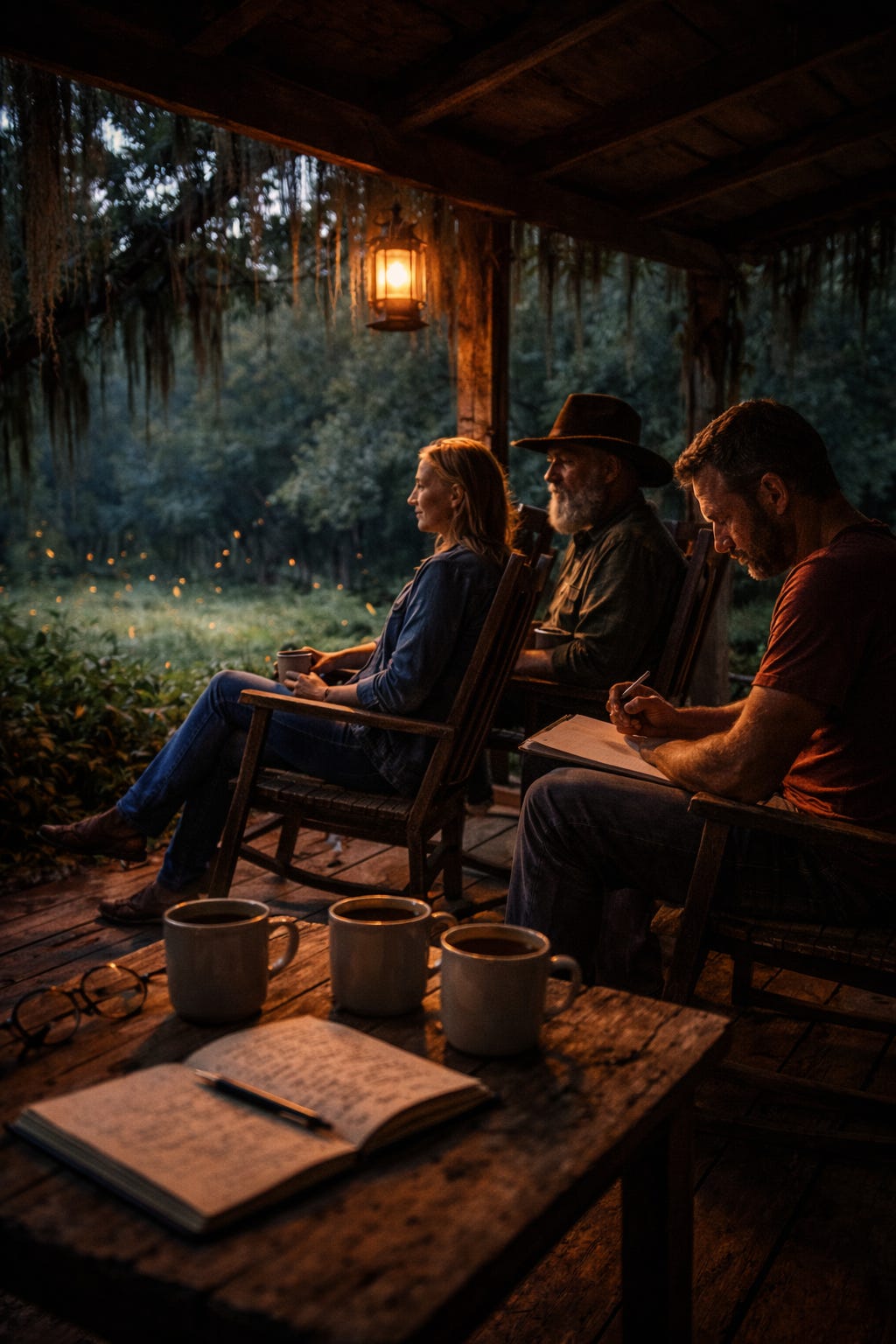
The Porch
A place where the South still remembers itself.
Dusk.
A porch that knows who it wants to entertain.
Grace
Grace doesn’t go looking for the porch. She finds it by following the only instinct she’s started to trust—the pull toward places that don’t ask her to perform.
She’s been talking more. Saying real things. Watching the world fail to collapse in response. That builds a quiet hunger—for somewhere she can stop bracing between sentences. Someone mentions a place where the air listens back. No fixing. No commentary. Just space.
She shows up at dusk because daylight still feels too exposed and night smells like old habits. Dusk is the truce hour. The porch knows this.
The first thing she notices isn’t the people. It’s that she can breathe without measuring it.
She stays because nobody asks her to explain herself.
That’s new.
That’s everything.
Hank
Hank gets there the hard way—by running out of momentum.
He’s been hauling miles and consequences, doing the right thing just fast enough not to think too hard about the wrong ones that came before. Rebuilding is lonely work when you don’t trust stillness.
He pulls in because the road goes quiet. Or the GPS hiccups. Or someone he trusts just enough says, You can park here for the night.
He expects judgment. Or advice. Or a sermon. What he gets instead is a chair that doesn’t care who he voted for or what he used to sell.
That disarms him more than anger ever could.
He stays because nobody asks him to perform redemption.
They let him be unfinished.
Beau
Beau didn’t claim the porch. The porch claimed him—no ceremony, the way the South does when it decides you’re worth the trouble.
He showed up once, passing through. Sat because his feet told him to. Stayed because nobody rushed him. Said a few things. Didn’t say more. The porch clocked him and thought: this one listens.
Since then, the boards remember his weight. He’s not a fixture or a host. More like a pressure system. Comes and goes. Tries to leave the air a little clearer.
He knows the rules because he learned them by breaking them. No grandstanding. No fixing. No politics unless you’re prepared to be tossed into the yard by the collective spirit of the place.
Beau understands the porch the way musicians understand a good room. You don’t dominate it. You play with it.
So when Grace arrives, he doesn’t greet her. He nods. Makes room. Lets the silence do the welcoming.
When Hank rolls in, Beau clocks the truck, the shoulders, the exhaustion—and says nothing that sounds like permission.
Permission isn’t his to give.
The porch already decided.
Why This Porch
This porch draws people who’ve learned—often the hard way—that noise is a currency and silence is usually sold too cheap. It keeps out the opinionated, the evangelical (of any stripe), the folks who mistake volume for truth.
It attracts those who have been wrong and survived it. Those who know the cost of certainty. Those tired of defending themselves.
Grace arrives because she’s learning to take up space.
Hank arrives because he’s learning to sit still in it.
Beau arrived some time back and sleeps in the back—unofficial tenant, unofficial weather pattern.
The porch isn’t neutral. It’s selective. It entertains those who can shut up long enough to hear the evening settle.
The First Evening
The first time they’re all there together, nobody knows that’s what it is.
Grace arrives first. Not early—carefully. Dusk still undecided. She chooses the chair closest to the edge, where leaving would be easiest. The porch allows this. The boards don’t creak beneath her.
Beau is already there. Not waiting. Just present. He tips his chin—I see you—and goes back to whittling nothing in particular with a pocketknife older than most apologies. The blade stops. Starts again.
Cicadas take over.
Hank arrives like weather. Truck cooling. Metal ticking as it lets go of the day. He stays standing at first, one boot on the bottom step, scanning like he expects to be told where he can’t sit.
Nobody tells him anything.
Beau finally says, “Chair’s honest.”
That’s it.
Hank snorts—half laugh, half release—and sits. The porch answers with a creak that sounds like recognition, not complaint.
Grace speaks before she can stop herself. “Does it always do that?”
“Only for folks who need to hear it,” Beau says.
The sky bruises purple. Fireflies test the air.
Hank breaks the silence. “Y’all mind if I don’t talk much?”
“I like when people don’t,” Grace says.
“Then you’re in the right place,” Beau says.
No résumés. No origins. No advice.
“I’m trying not to disappear anymore,” Grace says.
Hank nods once. “Yeah. That takes longer than most folks admit.”
“Porches help,” Beau says. “They don’t rush the process.”
They sit until the light gives up.
When Grace stands, she doesn’t feel like she’s fleeing. Hank stays put. Beau closes his knife.
“Spare room back there if anybody needs it.”
No promises.
No future outlined.
As Grace leaves, Beau says, “Dusk works both ways.”
She nods, holding something she can’t yet explain.
Pages
They’ve been meeting two weeks before anyone brings pages.
Hank drops a folder like evidence. “Wrote something. Don’t know if it’s any good.”
“Then why’d you bring it?” Beau asks.
“Because I don’t trust my judgment.”
“There it is.”
Hank reads. He has a good voice—steady, unshowy. The story’s clean. Observant.
It’s also completely safe.
When he finishes, the silence is less awkward than diagnostic.
“The waitress in Amarillo?” Grace says. “She’s you. You gave her all the good lines.”
Hank looks at the pages like they’ve betrayed him.
“She shows up for half a page and breaks my heart,” Beau says. “Your guy spends twelve pages feeling nothing.”
“He’s supposed to be numb.”
“Is he?” Beau taps the ending. “He orders pie. That’s dessert.”
Hank laughs, startled. “Jesus.”
“What does coming back to life actually look like?” Grace asks. “Literally.”
Hank stares at the railing. “I don’t know.”
“Then that’s the work,” Beau says.
Later, nothing is fixed. But something has shifted.
Hank works without chasing it. Pen out. Margins crowded with questions.
Grace watches fireflies—brief, exact flashes that refuse to last.
Beau brings coffee. Three mugs set down like ballast.
No one pushes the evening forward.
No one seals the moment or names the change.
They remain where they are—unfinished, alert, awake.
The porch doesn’t call that peace.
It calls it staying.
“A pocket knife older than most apologies” - nice!