

Grace found Norman Deavors on page forty-seven of the Southern Standard, wedged between an ad for an Asheville estate jeweler and a recipe for persimmon pudding that called for ingredients you couldn’t find south of a Williams-Sonoma.
She was third in line at the Publix on Main, cart loaded with the usual — green tea, boiled peanuts, several things Beau would eat and one thing he wouldn’t — when the cover stopped her cold. A well. Stone patio. A canopy built by someone with a plan. And below the photo, in the Standard‘s particular serious brand of serif that brooked no debate:
Norman Deavors, now 78, has been the Guardian of the Well for as long as anyone remembers.
She bought the magazine. She left the boiled peanuts.
Hank was in the parking lot with the engine running. She got in, dropped the Standard on his lap, and pointed.
He read it. Looked up. “Guardian of what now?”
“The well.”
“His well?”
“His well.”
Hank looked at the photo again. “And nobody knows what’s in it?”
“Nobody,” Grace said. “The magazine doesn’t ask.”
Hank considered this for approximately four seconds. “Highlands is four hours.”
“Three and a half,” Grace said, “if you drive like you mean it.”
Beau was on the porch of his trailer outside Social Circle when Grace called. She read him the Southern Standard piece over the phone, all of it, including the sidebar about the stonework. When she finished there was a silence that meant he was already reaching for his jacket.
“What’s he guarding it from?” Beau said.
“The magazine doesn’t say.”
“The magazine doesn’t ask,” Beau said. “Different problem.”
They picked him up at six the next morning. Jean-Paul rode in the back with a bungee cord around his middle because the mountain roads above Cashiers would tip him otherwise. The fog came in around Highlands proper, the kind that doesn’t burn off, just thins enough to remind you it’s still there. Rhododendron tunneled the road in over their heads. The truck dropped a gear climbing.
The lot at Maple and Oak was easy to find. Small towns make everything easy to find. The house sat on the corner — white clapboard, green shutters, the kind of porch that had seen three generations of the same sunrise. The redwood fence ran the full perimeter of the backyard, eight feet if it was an inch, and it was clear from the street that Norman had not built it to be decorative.
A hand-lettered sign on the gate read: THE WELL IS NOT OPEN TO THE PUBLIC.
Hank looked at Grace. “Friendly.”
“He’s protecting something,” Grace said.
“Sign says he is,” Beau said. “Question is whether he knows what.”
Grace knocked on the front door because Grace always knocks on the front door. Hank stood one step back with his hands in his pockets, which is his way of looking harmless, which mostly works. Beau stayed on the porch steps with a notebook he hadn’t opened yet.
They heard him before they saw him. A slow, deliberate progress through the house — not the shuffle of a man who has given up, but the measured pace of someone who sees no reason to hurry and several reasons not to. The door opened.
Norman Deavors was seventy-eight years old and looked like the mountain had made him personally. White hair swept back from a broad forehead. A canvas work shirt the color of old moss. He looked at Grace first, then Hank, then Beau on the steps, then back at Grace in the way of a man running a private calculation.
“You’re not from the Standard,” he said.
“No sir,” Grace said. “We read the Standard.”
Norman considered this distinction. “What’d you think of it?”
“I thought they didn’t ask the right questions.”
Something shifted in Norman’s face. Not a smile exactly. More like a door opening an inch to see about the weather.
“You’d better come in,” he said. “I’ve got coffee if you can stand it strong.”
The front room was orderly in the way of someone who lives alone and has made peace with it. Books on every surface but arranged, not piled. A La-Z-Boy aimed at a window that looked out on the side yard. On the mantle, a framed photograph of the well — not a snapshot, a proper black and white print, matted, the stonework catching light the way someone had waited for.
Hank looked at it a long time.
“You had that taken professionally,” he said.
“1997,” Norman said from the kitchen. “Fellow came up from Asheville. Took him half a day to get the light right.” A pause, the sound of cabinet doors. “Took me three years to build it. Seemed worth documenting.”
Grace drifted to the mantle. Up close the well was more elaborate than the Standard had shown — the stonework ran in a pattern that wasn’t random, concentric rings working outward from the base, each course a slightly different color of mountain granite.
“Mr. Deavors,” she said, “what are you guarding?”
Norman appeared in the doorway with three mugs, no tray, fingers through the handles the way men of his generation carry coffee.
“Sit down,” he said. “That’s a longer answer than it looks like.”
The coffee was strong enough to make Hank blink. Norman settled into the La-Z-Boy with the ease of a man returning to his natural habitat and wrapped both hands around his mug and looked at the three of them arranged on his sofa like he was deciding something.
“You know what was here before this house,” he said. It wasn’t a question.
“No sir,” Grace said.
“Nothing,” Norman said. “My grandfather built this house in 1919 on a corner lot that nobody wanted because there was no water. You had to haul it. Every drop. Up from the creek on Satulah, which in August was barely a creek at all.” He paused. “He dug that well by hand. Him and one other man whose name I never learned. Took them the better part of a summer.”
Beau had the notebook open now. He wasn’t writing anything. Just holding it.
“When they hit water,” Norman said, “my grandfather sat down on the ground next to the hole and didn’t move for an hour. His partner thought something was wrong. But he said later he was just listening to it. First water that land had seen. He wanted to hear what it sounded like.”
Silence.
“So that’s what you’re guarding,” Grace said. “That story.”
Norman looked at her with something close to approval. “That’s what the Standard wanted to hear.”
Hank leaned forward with the careful expression of a man approaching something that might startle. “What’s the other part?”
Norman set his mug on the side table. Pushed himself up from the La-Z-Boy with the careful momentum of a man who has learned to work with gravity rather than against it.
“Come on,” he said. “I’ll show you.”
The redwood gate had a latch that required knowing where to press. Norman’s thumb found it without looking. The gate swung in and they followed him through and stopped.
The Southern Standard had not done it justice. The stone patio ran twelve feet in every direction from the well, level and tight-fitted, not a weed in any joint. The canopy above the well was cedar, hand-pegged, the uprights carved at the top with something that wasn’t quite a pattern and wasn’t quite a figure but sat in the space between the two.
Climbing roses had taken the east side of the fence and been trained across a trellis that connected to the canopy’s edge, so that in another few weeks the whole structure would be roofed in bloom. Four iron lanterns stood at the cardinal points around the patio, the kind that took real candles.
And around the rim of the well itself, burned into the stone at intervals, letters.
Beau crouched to read them. They weren’t words exactly. Or they were words in something that wasn’t English.
“Latin,” Norman said. “Mostly. Some of it I made up.”
Hank looked at him. “You made up a language.”
“I made up the parts Latin didn’t cover,” Norman said, with the precision of a man correcting a small but important error. “There’s a difference.”
Grace had both hands on the rim of the well, looking down into it. The water was maybe fifteen feet below, dark and still and catching a coin of sky.
“What does it say?” she asked.
Norman clasped his hands behind his back. Looked at the letters like he was reading them fresh.
“Roughly,” he said. “It says: George found water. We found George. George found us. Long live water. Long live George. “
Beau wrote that down.
Then he stood up and did a full sweep of the patio without moving his feet.
The roses on the east trellis were the distraction. You looked at the roses. That was the point. And if you looked past the roses, past the canopy post, past the careful stonework, your eye hit something at ground level that your brain initially refused to process.
He thought: dead cat.
He looked up. Jean-Paul had materialized in the maple tree at the fence line. He sat on a branch with the composure of a critter attending a play he’d already read. He looked at Beau. He blinked once, slow, the particular blink that since Pensacola had come to mean pay attention, I’m telling you something.
Beau looked back at the thing by the canopy post.
Not a cat. He could see that now. The shape was wrong, too compact, too low, the face pointed and knowing even in stillness.
He looked at the next post. Same thing. Different position. Groundhogs? The lowly whistlepigs?
Eight of them. At least eight. Arranged around the well at intervals that were not accidental, each one oriented slightly toward the center, toward the water, like congregants facing an altar. The one on the elevated stone near the gate had a length of purple ribbon across its shoulders that Beau was not yet prepared to call a cape but was not prepared to call anything else either.
He elbowed Hank.
Hank looked. Hank’s jaw did something subtle.
“Sir,” Hank said, carefully, to Norman’s back. “Are those—”
“Ambassadors,” Norman said, without turning around.
Grace turned from the well. Looked at the groundhogs. Looked at Norman. Looked back at the groundhogs with the expression of a woman recalibrating not her opinion but her questions.
“Ambassadors,” she said.
“To the kingdom,” Norman said, as if this completed the thought, which for Norman it apparently did.
He turned around then, hands still clasped behind his back, and looked at the eight stuffed groundhogs with the frank proprietary satisfaction of a man surveying something he has built correctly.
“They tunnel up through the yard,” he said. “Have for fifty years. My grandfather called them pests. My father ignored them. I—” he paused— “I came to an understanding with them.”
Beau’s pen was moving. “What kind of understanding?”
“They keep to the perimeter,” Norman said. “They don’t undermine the patio. In exchange—” he gestured at the assembled parliament— “representation.”
Hank looked at the one with the purple ribbon. “Who’s that one?”
Norman’s expression moved through several territories before settling somewhere between pride and solemnity.
“That,” he said, “is Gerald the Fourth.”
Jean-Paul blinked again from the maple tree. Nobody looked up but Beau, and only for a second.
“There were three others,” Grace said.
“There were three others,” Norman confirmed.
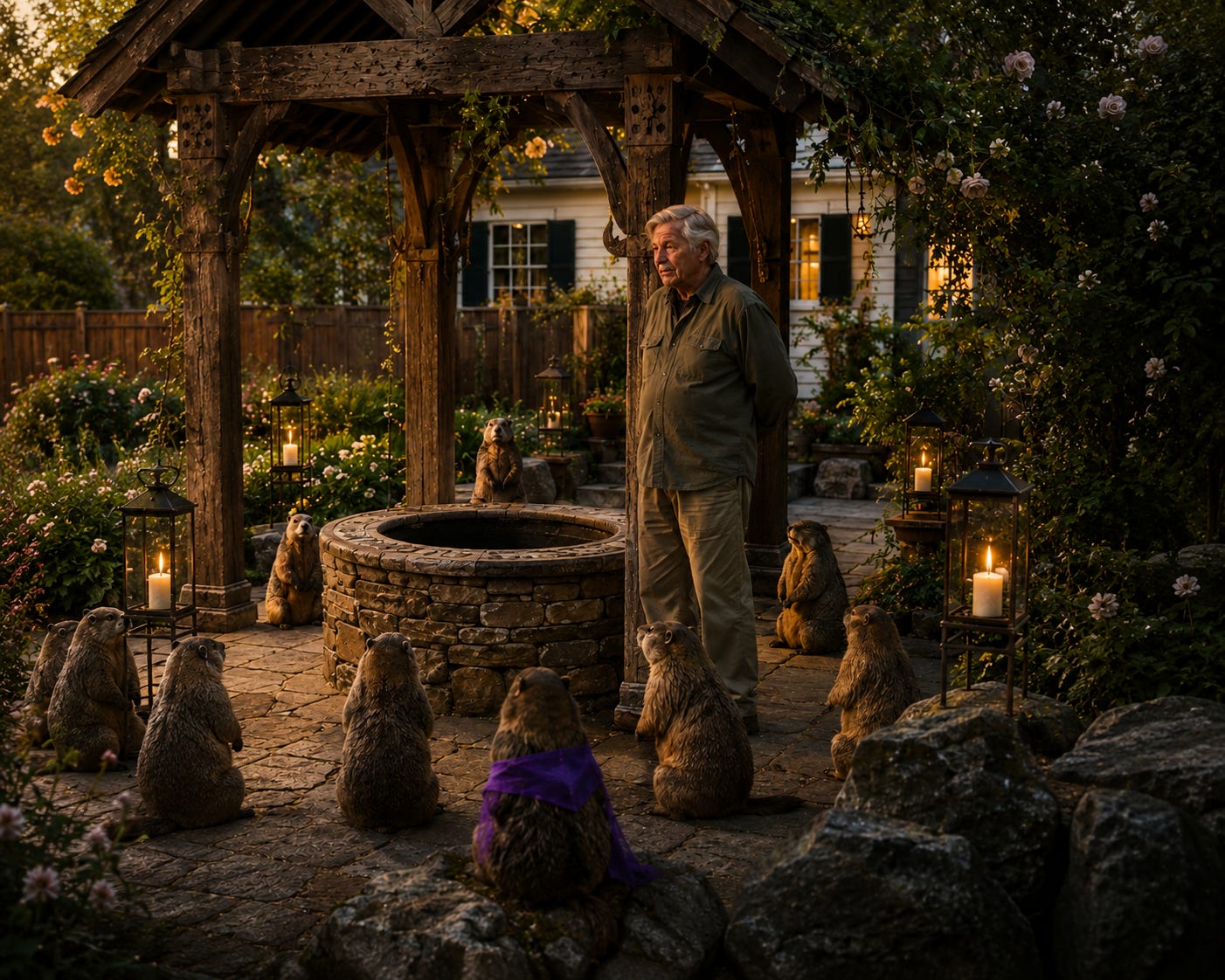
They stayed another hour. Norman gave them the full tour, which is to say he introduced them to each ambassador individually, by name, with brief biographical notes delivered in the tone of a docent at a small but serious museum.
Gerald the Fourth they had met. Gerald the First, Norman explained, had been discovered near the rose trellis in the spring of 1976 and had been, in Norman’s estimation, the most diplomatically gifted of the line. There was a pause after this that none of them filled.
Proceeding clockwise: Ambassador Ruthanne, who had been the first female representative and about whom Norman had strong feelings he did not elaborate on. Ambassador Deke, positioned nearest the well, who Norman described only as reliable. Two younger ambassadors whose names Beau wrote down and whose titles — Deputy Minister of the East Tunnel, Undersecretary for Perimeter Affairs — he wrote down more carefully, making sure he had the spelling right, which Norman appreciated.
“You’re taking notes,” Norman said.
“Force of habit,” Beau said.
“The Standard didn’t take notes,” Norman said. Not accusatory. Just observational.
“The Standard missed some things,” Grace said.
Norman looked at her. Then at the assembled parliament. Then back at her.
“They asked about the stonework for forty-five minutes,” he said. “Never once asked about Gerald.”
“Well,” Grace said. “We’re asking.”
Norman nodded slowly, the nod of a man whose patience with the world has finally, unexpectedly, been rewarded in a small but meaningful way.
“Come inside,” he said. “I’ll show you the archives.”
Hank looked at Beau. Beau looked at Grace. Grace was already following Norman through the back door.
Jean-Paul watched from the maple tree as the patio emptied. He surveyed the eight ambassadors with his alien eye, blue-green in the afternoon light. Gerald the Fourth’s purple ribbon stirred in the mountain breeze.
Jean-Paul blinked once.
Professional courtesy.
The archives were in a boot box, the serious kind, reinforced along the edges with brown packing tape applied with some care. Norman set it on the kitchen table and removed the lid and stepped back in the manner of a man who has learned to give people a moment.
Inside: a composition notebook labeled in ballpoint — GROUNDHOG KINGDOM: DIPLOMATIC RECORD, VOL. 4. Beneath it, three more volumes. Beneath those, a folded piece of graph paper that turned out to be a hand-drawn map of the tunnel system, updated annually in a different color ink for each year, the result being a document that looked like what would happen if a seismograph and a subway map had a disagreement.
And beneath that, a photograph.
Norman picked it up and handed it to Grace without comment.
It was Norman, many years younger, crouched on the patio next to a groundhog. Not stuffed. Alive. Looking at the camera with the blank agenda of a groundhog who has not yet been told he is an ambassador but is open to the concept.
“Gerald the First,” Norman said.
Grace looked at the photograph for a long time.
“You knew him before,” she said.
“That’s the day we reached the understanding,” Norman said. “He came up through the yard and just — stopped. Right there by the well. Looked at it. Looked at me.” Norman sat down at the kitchen table. “I don’t know what he saw. But he came back the next day. And the day after. Brought two others eventually.”
“Norman,” Beau said. “What are you actually a doctor of?”
Norman looked at him mildly. “Veterinary medicine. Small animals. Retired.”
Beau wrote that down slowly, the way you write something down when it has just explained everything and nothing simultaneously.
“Come upstairs,” Norman said. “There’s more.”
The attic stairs were behind a door in the hallway that looked like a closet and was not a closet. Norman opened it without ceremony and started up and they followed in single file, Grace first, then Hank, then Beau, who paused at the bottom and looked up into the light coming down from above and had the brief feeling of a man about to see something he could not unsee.
He went up anyway. Journalism is mostly that.
The attic ran the full length of the house, floored, insulated, two gable windows throwing long pale rectangles of mountain light across the room. It smelled of cedar and old paper and something faintly animal that was not unpleasant, just there.
One wall was the tunnel map. Not the folded graph paper from the shoebox — that was the field copy. This was the master. It covered the entire north wall floor to ceiling, hand-drawn on drafting paper panel after panel, forty years of groundhog infrastructure in a different color ink for each year so the whole thing looked like a topographical fever dream. Little flags marked points of interest. Norman had developed his own cartographic notation system. There was a legend.
Hank stood in front of it for a long time.
“Norman,” he said, with the diplomacy of a man who has learned that how you ask a question matters as much as the question. “Is that a senate chamber?”
“Bicameral, technically,” Norman said. “Though the lower house hasn’t been active since Gerald the Second’s administration. There was a schism.” Hank nodded. Filed it. Moved on, because some doors you open and some doors you just acknowledge.
Grace had drifted to a display case along the east wall — glass-topped, the kind you’d see in a natural history museum — that held a collection of objects on velvet. Groundhog incisors, labeled by ambassador and date. A cross-section of tunnel wall, mounted on board, showing the chamber divisions with a small placard beneath: DOMESTIC INFRASTRUCTURE. Excavated 2014. Ambassador Ruthanne’s primary residence.
“He labeled the bathroom,” Grace said, to no one in particular.
“She was meticulous,” Norman said, with what was unmistakably fondness.
It was Beau who spotted the Phil wall.
It occupied the far end of the attic, between the second gable window and a shelf of composition notebooks, and it had a different energy from the rest of the room. Where the other walls were orderly and scientific, the Phil wall was annotated. Newspaper clippings and magazine articles going back decades, all of them about Punxsutawney Phil, and all of them bearing Norman’s red pen in the margins with a density that suggested long evenings and strong feelings.
Beau leaned in to read one.
“Shadow or no shadow — this is not meteorology. This is theater. Phil hasn’t seen his shadow in thirty years because Phil lives in a climate-controlled enclosure and is brought out by men in top hats. Gerald the First predicted the 1983 superstorm four days in advance from burrow behavior alone. Nobody put Gerald the First on television.”
Beau straightened up. “Hank,” he said, in the careful tone of a man delivering news. “Come look at this.”
Hank came. Read. Rubbed the back of his neck.
“Norman,” he said. “How do you feel about Punxsutawney Phil.”
Norman’s expression moved through several territories before settling on a controlled and long-practiced neutral.
“Phil,” he said, “is a prop.”
Beau’s pen was already moving.
“Phil is brought out of a heated den by men in formal wear once a year for the benefit of cameras, and his prediction is announced by a man reading from a scroll, and his accuracy rate is statistically indistinguishable from a coin flip, and he has been held in captivity for decades, and the people of Pennsylvania have named him an ambassador of the natural world—” Norman paused. Collected himself. “Gerald the First predicted seventeen weather events of significance from burrow behavior alone. I have the data.”
He crossed to the shelf of composition notebooks and produced one without hesitation, the way a man produces evidence he has been waiting a long time to present.
“Did you know they whistle?” Norman said. He looked at Beau directly. “Whistlepigs. They whistle because they’re warning each other.” He set the notebook down. Composed himself again. “Phil doesn’t whistle. Phil ain’t whistled in thirty years. Phil is—” a pause— “Phil is a failure of imagination dressed up as a tradition.”
The attic was quiet except for the mountain wind working at the gable window.
Grace put her hand on Norman’s arm.
“Norman,” she said gently. “Have you ever tried to tell anyone about Gerald?”
Norman looked at her. Then at the Phil wall. Then at the tunnel map behind them, forty years of careful color-coded ink.
“The Standard came,” he said. “They took pictures of the stonework.”
They came down from the attic in the late afternoon, the mountain light going gold and thin through the kitchen window. Norman put the coffee on again without asking. Grace sat at the table. Hank leaned in the doorway. Beau closed his notebook, which for Beau meant the real listening was starting.
Norman set the mugs down and looked out the window at the backyard. Gerald the Fourth was visible through the glass, purple ribbon catching the last of the light.
“I talk to them,” Norman said. “In case you were wondering.”
“We weren’t wondering,” Grace said. “We assumed.”
Norman almost smiled. “Gerald the First used to whistle back. Not every time. Just when he felt like it warranted a response.” He wrapped his hands around his mug. “Gerald the Fourth doesn’t whistle much. More of a thinker.”
Hank looked at the window. Looked at Gerald the Fourth. Looked back at Norman with the careful expression he reserved for moments when the world had exceeded his available frameworks.
“Norman,” he said. “What are you actually guarding out there?”
Norman was quiet long enough that the refrigerator cycled on and off.
“My grandfather sat next to that hole for an hour,” he said finally. “Listening to the water. My father walked past that well every day of his life and never stopped once.” He looked at his coffee. “I stopped. And then something came up out of the ground and stopped with me.”
Nobody said anything.
“I don’t know what’s down there,” Norman said. “The water. The tunnels. Whatever the tunnels know that we don’t. I just figured somebody ought to pay attention to it.”
Outside, Jean-Paul dropped silently from the maple tree to the fence post to the ground, landing without a sound in the backyard. He regarded Gerald the Fourth with his alien eye, now amber in the fading light. Gerald the Fourth regarded him back with the blank diplomatic patience of a groundhog who has seen stranger things come through this yard and expects to see stranger still.
Jean-Paul blinked once.
Gerald the Fourth did not whistle. But his nose moved. Barely. Decisively.
Nobody saw it but Beau, and Beau didn’t write it down.
Some things you just leave in the yard where you found them.
They said goodbye on the front porch as the fog came back down off the mountain the way it does in Highlands, not dramatically, just insistently, until the square at the bottom of the street was mostly suggestion.
Norman shook Hank’s hand. Nodded at Beau. Looked at Grace.
“You were right,” he said. “The Standard didn’t ask the right questions.”
“You should have more visitors,” Grace said.
“I have the ambassadors,” Norman said.
He went inside. The door closed. The porch light came on, not because it was dark. Norman Deavors was the kind of man who turned his porch light on when company left.
Wow. Had me googling Groundhogs. Groundhog day.... Listening to the water. Guardian/guarding of the Well. Ambassadors - To the kingdom. Wow.