This is the second of a two-part series. the first Part is HERE.
Seven: Coldpine
The quarter share came in heavier than anyone had let themselves expect, and still Dry Elm complained about it.
“A quarter,” he said, working a knot out of a drag-rope with his teeth and his fingers both. “For coming farthest and losing the most seasons to it.”
“Losing what seasons.” Bent-Willow didn’t look up from the hide he was folding. “You were seven the last time Coldpine ran its own jump. You’ve been eating Longwater’s count since before you could carry a bow.”
“I know the history.”
“You know the complaint. That’s different.”
That got a laugh out of two of the younger men crouched near the fire, packing dried strips into a hide sack between them. Dry Elm let it go. No argument that New Needle had settled the terms himself, hand to hand with Stone Face, and nobody under him was going to unsettle what the elder had already closed.
“My grandfather says Longwater still owes us for the buffalo his grandfather stole,” said one of the strip-packers, a boy called Birch-Water, young enough that saying “my grandfather says” was still the whole of his authority on anything.
“Whose grandfather. Stone Face’s or yours.”
“Stone Face’s. Mine just tells it.”
Bent-Willow set the folded hide down. “You know the story, then. What he did.”
Birch-Water knew there was a story. He knew Coldpine didn’t offer Longwater men their open hand at trade, hadn’t in his father’s life or his own. He didn’t know the real story — what was taken, from whom, in what season — only that it had happened, the way a boy knows a river is dangerous somewhere upstream without knowing which bend.
“No,” he admitted. “Just that there was one.”
“There was one,” Bent-Willow said, and didn’t go further, and none of the younger men pushed him to, because an older man choosing not to finish a thing was its own kind of answer, same as ever.
Dry Elm went back to his knot. “Doesn’t change the count.”
“No,” Bent-Willow agreed. “It never has.”
They worked through the rest of the light without much more said about it, filling sacks, securing the drag-ropes. An argument broke out briefly over whether the smaller hides should travel with the meat or separately, settled the way most things got settled among them, by whoever had carried the heavier load that day getting the final word.
A runner came through near dusk asking after spare sinew for the Tallgrass camp, and Birch-Water gave up more than he’d been told to, because refusing a neighbor’s runner over sinew wasn’t the kind of stinginess Coldpine wanted a reputation for, whatever else it was known for.
New Needle passed near the fire once, checking on nothing in particular the way an old man checks on things once his real work for the day is done. He looked at the sacks a moment, counted them without seeming to, kept walking.
“He still hate them?” Birch-Water asked, once the old man was out of hearing.
“He remembers,” Bent-Willow said.
“Looked like hate today. Out at the terms.”
“Everything looks the same from where you’re sitting.” Bent-Willow picked the hide back up. “Fold the corner in. You’re wasting half the hide leaving it square.”
Birch-Water folded the corner in, and didn’t ask again. The fire burned on toward the meal nobody had started yet, four fires down from where the actual blood work was being done, closer to the cliff, where the smell hadn’t stopped since morning and wasn’t going to for days.
Eight: The Cliff Base
The wounded ones went first, before the dead were touched at all.
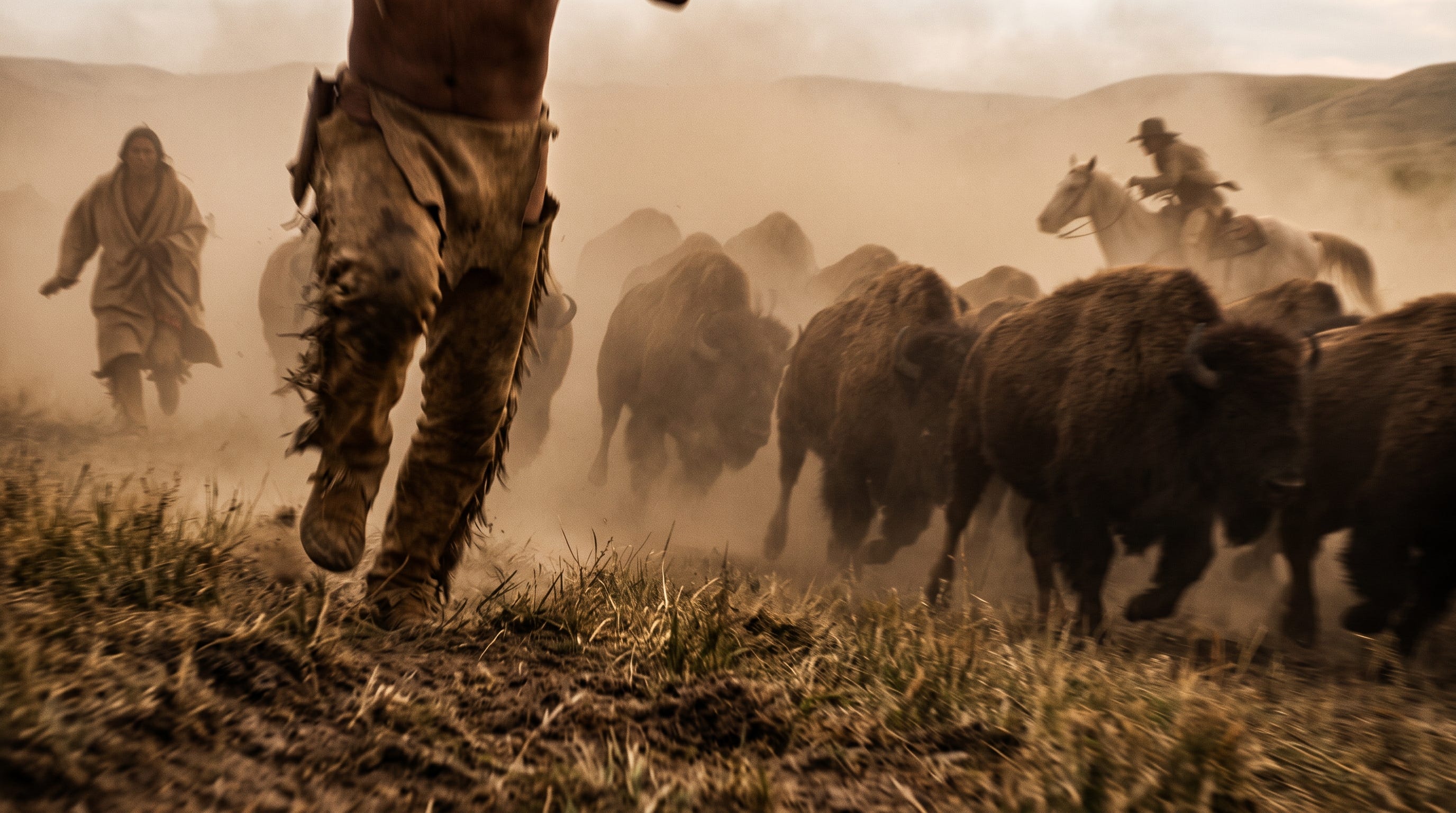
A bull with both forelegs shattered under him could still take an arm off a careless man, so the finishing crew worked in pairs — one to hold the head still by the horn, one to put the spear in behind the shoulder, angled down, through to the heart.
Done right it took one thrust. Done wrong it took three, and a bull that had already survived a hundred-foot fall onto broken rock was not an animal inclined to hold still for a fourth try at it.
Two strong women worked a pairing. A young man with a strong arm and no patience got set beside an older one who’d done this every season since before the young man was born and wasn’t going to hurry for him.
Between them they moved down the base of the cliff in a rough line, animal to animal, the calling-out and the answering-back the only ceremony any of it got. Down here. This one’s still breathing. Bring the long spear, this one’s got some fight left.
The ones already dead got opened next, gut first, to let the heat out before the meat inside started working against itself. A boy of nine or ten stood at each opened carcass with a horn cup, catching what blood could still be caught before it soaked into the ground, because blood boiled down thick was worth having and none of the animal was wasted on purpose.
Older women came behind the openers with stone knives, taking the liver first, warm, eating a little bit of it standing there, collecting the rest in a hide for the council and the medicine tent.
The smell was already thick enough to taste. Nobody spoke of it, because there was nothing useful to say about a thing that wasn’t going to change and needed working through regardless.
Sharp Knives moved along the line all morning, trading dull blades for the ones he’d finished, no fewer than forty passing through his hands by midday, no two the same length or weight, each one back in service inside a few minutes.
A boy ran the exchange for him, since Sharp Knives himself moved slow on the uneven ground. Between the two of them the line never once stood waiting on a blade.
By afternoon the eleven standard sections were coming off each carcass in order. The four legs first, then the ribs split from the spine in two long racks, then the brisket. The hump and neck meat worked loose last, since it was toughest and least likely to spoil quickly.
Every piece had a place waiting for it before it was cut: the drying frames, the boiling pits, the hide-scraping ground twenty yards off where the flies hadn’t yet gathered. Bone went into its own pile, sorted rough by size, the big leg bones set aside whole for the marrow crews, the smaller pieces bound for the grease pits once there was room at the fires to boil them.
Nothing went to waste on purpose. What the people didn’t want, the camp dogs took, worrying the smaller scraps at the edges of the work with an entitlement nobody bothered to correct.
What the dogs didn’t take stayed on the ground until the wolves came for it after dark.
By the time the sun was nearing the horizon, the forty-one carcasses had become eleven sections each, meat and bone and hide moving toward different fires and frames and pits, each one someone’s specific job, none of it anyone’s alone.
Nine: The Staking Ground
A green hide weighs as much as the girl scraping it, but no part of the work goes faster for wanting it to.
The staking ground sat downwind of the butchering, close enough to walk a hide over while it was still workable, far enough that the flies hadn’t yet descended on the operation, at least not in full swarm. Each hide went down flesh-side up, staked at a dozen points with sharpened pegs, pulled tight enough that a hand pressed flat against it found no give. Loose meat and fat came off first, worked with a flesher made from a leg bone split and ground to an edge — long strokes, shoulder to hip, the same motion repeated until the whole hide showed pale and clean and the arm doing it had stopped feeling much of anything below the elbow.
It would then sit a day in the sun, staked and stretched, drying stiff as bark, and there was nothing to do but wait and mind it didn’t curl at the edges. And keep the predators at bay.
The brains went in next. Every hide got its own animal’s brain back, worked into a paste with a little water and rubbed into the flesh side by hand until the whole hide had gone soft and slick under the fingers.
An old Tallgrass woman working three stakes down from a Longwater girl half her age explained it without being asked, the way an old woman explains a thing she’s decided a younger one ought to know now rather than later. Every animal carries enough brain to tan its own hide. Always has. Nobody’s ever figured a reason for it. Nobody’s ever needed one.
The girl worked her hands into the paste.
After the brain came the softening, which was the part that turned a stiff sheet of hide into something a person could wear or sleep under or sell — hours of pulling the hide back and forth over a length of twisted sinew rope, or working it hand over hand across the dulled edge of a bone tool, breaking down the fibers a little at a time until the hide went from stiff to pliable to something close to cloth. Two women could trade off a single hide for the better part of a day and still finish exhausted.
The last hides, the ones meant to hold shape rather than fold soft — the ones bound for lodge covers, not clothing — got smoked instead of worked further, hung over a pit of smoldering, half-green wood until the smoke had worked all the way through, which was what kept a hide from stiffening up hard again the first time it got wet. A hide smoked wrong came out either too pale to hold water or so dark it cracked in the cold. There wasn’t much room for guessing about it. The women in charge didn’t guess.
By dusk the staking ground held better than thirty hides in some stage of the process, a few finished and folded, most still stretched and drying, two ruined outright — one torn clean through by a bad flensing cut, one gone stiff past saving after a rain squall nobody had planned around.
Nobody made much of the losses. Thirty-nine good hides off forty-one animals was a better count than most seasons. The two that failed went into the scrap pile with the rest of what wasn’t fit to keep; the dogs would work through them by morning.
The Duskhorn women worked the far end of the ground, keeping mostly to themselves, though a Tallgrass girl had drifted down to trade turns on a stiff hide none of them could soften alone. Nobody told her not to.
Ten: The Women’s Fire
The women’s fire sat apart from the work fires, upwind, close enough to the creek that a person could hear it without needing to look for it. It was the one place in the whole gathering where all four tribes sat mixed rather than sorted by camp.
Nobody had decided that on purpose. It had simply always been that way, long enough that no one thought to ask why, the same as nobody asked why the men kept to their own fires on the ridge. Some things sorted themselves.
A Duskhorn woman named Late Berry was retelling, for at least the third time, the story of how her husband traded away his own good knife for a dog that turned out to already belong to somebody else.
It got a better laugh each time she told it, which was its own kind of skill, and one of the younger Coldpine women asked, not unkindly, whether any of it had actually happened the way she said.
“Enough of it happened,” Late Berry said, “that he still won’t touch that dog.”
The mending sat in every lap at once — torn seams, a split moccasin sole, beadwork someone had started and set down mid-pattern weeks ago and was only now getting back to. A Tallgrass girl working a strip of quillwork held it up for the fire to catch and asked whose pattern it favored, since she didn’t recognize the stitch.
“Braids the Smoke’s,” said an older Longwater woman, not looking up from her own work. “She traded three winters running for good beadwork, back when there was beadwork worth trading for. Half the women here are still working patterns she taught somebody who taught somebody else.”
“The one who used to sing at night?”
“That’s her.”
“My mother said she’d go clean out past the horse line some nights and just sing. Not sad singing. Loud, like she meant the whole camp to hear it whether they wanted to or not.”
“She meant exactly that,” the older woman said, and went back to her stitching, and nobody pushed further, because that was as much of an answer as the fire needed and everybody at it already half-knew the rest.
A dispute broke out over whether the second batch of dried meat from the east racks had cured enough to bundle, two women disagreeing hard enough that a third had to physically check the strips herself before either of them would let it go, and she came back with a verdict neither had wanted — another half day, minimum — and both accepted it without further argument, because a third party’s hands on the actual meat settled things faster than any amount of talking.
Somewhere in the middle of all that, without anyone quite steering the talk there, it turned to Little Cloud.
“Fourth season,” Late Berry said. “Alone this time.”
A Tall Grass woman asked, “what happened to Braids the Smoke?”
“She gashed her leg on a river rock in the spring. Must have been a dead animal in the water nearby. She swelled up and died. Now Little Cloud is making the pemmican alone.”
“She’s not alone. Sharp Knives is right there.”
“He sharpens knives. That’s not the same as standing over a vat telling six grown men what to do.”
“She did it, though.” This from the Longwater woman with the quillwork. “Rack came down before the rain hit. I saw it myself.”
“So did her mother, every season before this one.”
“So will she, every season after.”
Nobody argued that last part, and the talk moved on to whether the Duskhorn boy had actually been found or whether that was only camp talk covering for something worse, and nobody at the fire had a real answer either way, which didn’t stop three different women from offering three different guesses before the subject wore itself out and the mending took over again.
By the time the light started going amber, the fire had produced two finished moccasin soles, most of a bundle of dried meat re-tied and set aside for morning, a length of quillwork nobody quite finished, and no fewer than four separate pieces of camp business that would reach every other fire in the gathering before the night was through, carried the way that kind of news always traveled, mouth to mouth, faster than smoke and considerably less reliable.
Eleven: Sharp Knives
He didn’t come to the Longwater fire until the sun was most of the way down, but the ones who knew to wait for him knew why.
A Coldpine woman had heard about his skills, was there first, waiting. A magpie had sat over her family’s fire two mornings running, silent, watching rather than scavenging.
“What does it want.”
“Nothing. It wants nothing at all. That’s what unsettles you. You’d rather it wanted something.” She hadn’t asked him what unsettled her. She stood there a moment with that sitting on her wrong, and then she asked him the real question, the one under the bird.
“Will my son hunt again?”
“The wind doesn’t answer things that plainly.” He stood, and turned from her, out toward the dark past the fire, and said something low that wasn’t meant for her, three words, maybe four, in no register she recognized as speech exactly, more the shape speech takes when it isn’t meant for a listening ear. The fire guttered sideways, hard.
“He’ll hunt,” Sharp Knives said, when he turned back. “Not the way he did before.” She left with less than she wanted but more than nothing, which was what he gave anyone. The Longwater knew that going in.
He hadn’t always been a man people waited on after dark. There’d been a time his legs carried him, same as any hunter, before the fall that took the strength out of his left side. It took with it the only currency a young man needed. But he didn’t hunt after that. He didn’t lead. What was left to him was the knives. Honest work. For a long time that was what people expected of him.
Something else had grown in under that, slow, the way a thing grows in a wound left alone too long. Nothing anyone would call sickness to his face, but a distance in him that hadn’t been there before, an ease around things most people flinched from. He’d stopped minding the dark the way other men minded it. He’d taken up talking to wind and fire and the shapes birds made against the sky. Where another man might have been pitied for it, or feared outright, Sharp Knives had simply become the man people waited for after the sun went down. He answered things a knife couldn’t.
Little Cloud didn’t come to that fire. She had her own way with the dead. He’d have done it if she’d asked. She never asked, and he never offered, and that was its own kind of understanding between the two of them.
A boy came last, fevered, carried by a mother whose fear had outrun her by the time she reached him. Sharp Knives didn’t touch the boy’s forehead the way another man might have, checking heat with a palm. He crouched close, put his mouth near the boy’s ear, and said something the mother didn’t catch and wasn’t meant to, and the boy’s breathing changed under it, evened out.
“Aspen bark, if you have it, oiled with calf fat.” he told the mother after. “The wind only carries so much of a fever off. The body finishes what’s left.” She left him a small charm made from a snail shell, and went to find bark.
Sharp Knives sat back down by the coals, didn’t speak again to anyone for a long while, watching the dark past the firelight the way another man might watch a door he expected someone to come through.
Twelve: Wolves
The wolves came at full dark. Watch fires went up along the base of the cliff a good hour before that, spaced close enough that no stretch of ground sat fully dark between two of them.
Eight men held the first watch, two from each camp, which was how it always got split. Nobody trusted a watch made up heavier from one fire than another. Not because anyone expected trouble from it. Just because that was how a fair watch worked.
Fast Horse sat the Longwater side nearest the old kill ground, a spear across his knees, still favoring the shoulder he’d landed wrong on during the drive.
The wolves didn’t rush anything. They worked the dark beyond the firelight in twos and threes, patient, circling toward whatever scrap pile sat least defended, and the job wasn’t killing them, it was simply being present enough, loud enough, awake enough, that the animals kept their distance and worked the true edges instead of anything a person still needed. A thrown rock did as much work as a spear most nights.
The pipe went around twice before anyone said much of anything, which was usual. Talk came slower at night than in daylight, the men mostly listening for sounds in the dark.
A Duskhorn man called Broken Antler told the same story he told most watches, about a bear he’d faced down as a boy that had, by his account, grown a foot taller each year he’d told it.
“Your bear’s going to be taller than the cliff soon,” Fast Horse said, and Broken Antler said that was exactly the size it had felt, at the time. The men laughed.
Somewhere past midnight a Tallgrass man and a young Coldpine, a hot-tempered buck nobody much liked sitting near — got into a scuffle over a bet. Two tired men with too much dark and too little sleep between them.
It went from words to shoving fast enough that the fire nearest them scattered, and for a few seconds it looked like it might actually turn into something.
Four men had them apart before it went further. Not gently. An arm locked hard around the Coldpine man’s throat from behind, another man’s whole weight dropped onto the Tallgrass man’s shoulders to fold him down into the dirt.
“You want the herd up and the wolves in on top of it?” That was Fast Horse, still holding the Coldpine man’s arm bent back further than was comfortable. “Sit down. Both of you. Sit down or walk back to your own fire and don’t come back to this one.”
They sat down. The argument wasn’t worth what it would have cost if the noise carried. Every man on that watch knew it before Fast Horse said it.
The pipe went around again once things had settled, and inside a short while the two of them were near enough to civil that one offered the other a strip of dried meat off his own belt, which got taken.
Near the darkest part of the night, a shape came close enough to the firelight that three men stood at once, spears up. A scrawny yearling wolf, bolder than the rest or hungrier, testing how close it could get before something answered. A rock answered it. It didn’t come that close again.
By the grey hour before real light, the watch had held. The meat and drying racks were untouched, nothing lost.
As the next watch came up to relieve them, Fast Horse walked back down toward the camp fires stiff through the shoulder, hungry, and satisfied the way a man is satisfied by a night where nothing worth remembering happened. Which was the only kind of night this work was ever meant to produce.
Thirteen: Stone Face
I found Little Cloud at the meat-tally fire near dusk, going over the work details with Sharp Knives. I waited until she’d finished before I said anything.
“Thirty-nine hides,” she said, mostly to her father, mostly to herself. “Better than we had any right to expect.”
“Better than most seasons,” I said. She looked up like she hadn’t noticed me standing there, which she had, and we both let that be the joke it was.
“Fast Horse still limping?” I asked her.
“How would I know.”
“You’d know.”
“I wouldn’t.”
“You watched him get thrown off that horse like it was the only thing happening on that whole field.”
“I watched a man nearly get trampled. Most people would look.”
“Like the look you gave him at the dance the other night?”
She threw a scrap of hide at me, not hard, and missed on purpose by enough that we both understood it was on purpose.
Braids the Smoke used to throw things at me the same way, when I’d caught her at something she wasn’t ready to own up to yet. Not embarrassed, just unwilling to give a man the satisfaction of being right out loud. Little Cloud has more of her mother in her than either of them would have admitted to my face.
Sharp Knives excused himself toward the knife pile, giving us the fire, the way he generally did when Braids came up between us.
“Your mother would have liked this season,” I said. “Good count, good hides, no one starving before spring. She’d have liked the way you handled the arguments at the vat. She always handled it well. You did too.”
“You were watching?”
“I saw.”
“I still hear her sometimes,” Little Cloud said, not looking at me when she said it, working a knot out of a drying-cord instead. “Like she never really left the fire.”
“I know.”
“You hear her too?”
“Every day. She saved me from a real injury up on the mesa.” She didn’t ask me to say more than that, and I didn’t offer. A thing neither of us needed spoken to understand.
She’d asked her mother once, years back, whether I was more to her than an old friend, and Braids had answered some other question instead. Breezy, the way she answered anything she didn’t feel like answering directly.
Little Cloud had let it go then. She let it go now too, the same way. Nothing needs to change.
“I think I hear her singing some nights.” Little Cloud said instead. “Out past the horse line. I keep meaning to go out there myself, some night, and I keep not doing it.”
“Sing badly enough and the wolves will leave the meat alone out of pure confusion.” Laughter.
“She never sang badly.”
“No,” I agreed. “She didn’t.”
We sat a while longer without much more said, the fire working down toward coals, the tally sheet of hides and bundles laid out between us like its own kind of ledger.
Out past the drying racks Fast Horse walked by carrying a fresh armful of firewood, not looking our way, and Little Cloud didn’t look at him either, with an effort visible enough that I let myself enjoy it a moment longer before I let her off the hook.
“Fast Horse just walked by,” I noted. Little Cloud punched my arm.
“Thirty-nine hides,” I said again, standing. “Tell your father I said the count was good.”
“Tell him yourself. He’s twenty feet away.”
“I know where he is.”
I walked off toward the drive lines before either of us had to decide whether that last exchange meant anything.
Sharp Knives and I have always kept a respectable distance, never once discussing it, which has suited all three of us, whatever we actually are to one another.
Fourteen: Camp Breaks
Duskhorn left first, preferring to travel in the long light. Their share went out on drag-frames behind what horses they had and on the backs of the rest of them. Nine hides, four bundles of pemmican, three of dried meat, the bone-grease jars wrapped tight in scrap hide against breakage.
The boy’s father found Stone Face once more before they went, not to argue anything further, just to say the count had come out fair. Stone Face said the boy would be welcome on a drive again once he’d grown into the nerve he already had. That was true, and both men knew it.
Tallgrass went next, midmorning, in better spirits than they’d arrived in — sixteen hides, the largest single share of pemmican outside Longwater’s own store.
The Tallgrass girl who’d traded turns softening hides with the Duskhorn women walked the last stretch of the departure beside them rather than her own people, laughing about something none of the Longwater women could make out. That kind of drift happened at the end of every gathering, and unwound itself again the moment everyone was back in their own country.
The Coldpine took the longest to break camp, even though they’d come the farthest and had the most ground to cross getting home.
New Needle found Stone Face at the drive lines while the last of his people loaded out — eleven hides, better than ten head of processed meat by weight, the fat off the shoulder cuts exactly as agreed.
“A good count,” New Needle said.
“A fair one.”
“Those aren’t always the same thing.” He said it without heat, an old man’s observation rather than a young man’s grievance. “This year they were.”
He put his hand out. Stone Face took it.
“Until next season,” New Needle said.
“Until next season.”
Whatever debt still sat between their two names went with New Needle back toward Coldpine country, unpaid, unmentioned, the way it had traveled every season before this one and would likely travel every season after. A thing carried rather than settled.
Longwater broke camp last, since there was nowhere for them to go. The jump site was their own ground, and what remained after the other three tribes packed out was theirs to store through the winter that was now, by every account, going to be a good one.
Hides finished clean. Enough pemmican, by Little Cloud’s own count, to see the whole camp through to the first green growth, with margin left over in case the winter ran long. Meat drying on long racks.
Mist-Walker, the old Longwater chief, came down from his own fire once the other camps were gone, walked the drying racks and the storage pits himself, slow, the way an old man walks a thing he means to actually look at. Said nothing to anyone the whole way through, a silence that was understood by every person watching him. Great success. And gratitude.
By evening the great camp that had stood at the base of the cliff for the better part of two weeks was down to Longwater alone, fires banked lower, the ground already starting to look like ordinary ground again rather than a place where a small city had briefly stood.
Little Cloud worked the last hour of full light alone, checking the final bundles one more time before covering them for the night. It was the last thing left to do before the fire was trimmed for the night.
The wind had swung around clean out of the north by the time she finished, cold enough now to mean something, cold enough that winter was no longer a thing anyone needed to prepare for in the abstract. She banked the fire low, stood a moment in the settling dark.
Somewhere out past the horse line, faint enough that she couldn’t have said afterward whether she’d truly heard it or only wanted to, what might have been singing carried a few notes on the wind. She didn’t go looking. No need.
Fourth season, done. Nobody was there to tell her she’d done it right. She already knew.